GEO, or Generative Engine Optimization, can help small businesses in Pakistan make accurate, useful information easier to discover and reference during AI-assisted research. The practical work includes clarifying services, improving accessible website pages, and providing evidence that helps customers assess suitability. These improvements may support discovery, but they cannot guarantee an AI mention, website visit, or sale.
For an owner managing enquiries, stock, or appointments, the starting point is the information customers need to make a decision. Fix that information first, then investigate whether AI-assisted discovery contributes to useful business outcomes.
What is GEO, and how does it work?
Generative Engine Optimization is the practice of improving content and business information with visibility in generated answers in mind. Here, GEO means generative engine optimization, rather than geographic advertising or location targeting.
A person asks a research question; a search-enabled AI system may consult sources and synthesize an answer. For Google specifically, AI Overviews and AI Mode can use multiple related searches, and their responses and supporting links can vary. AI Overviews do not appear for every query. Google’s AI features guidance explains these distinctions.
An AI source citation is a reference to supporting material in an answer. A business-directory citation is a listing or mention of business details elsewhere online. Neither should be confused with a customer visiting your website or choosing your business.
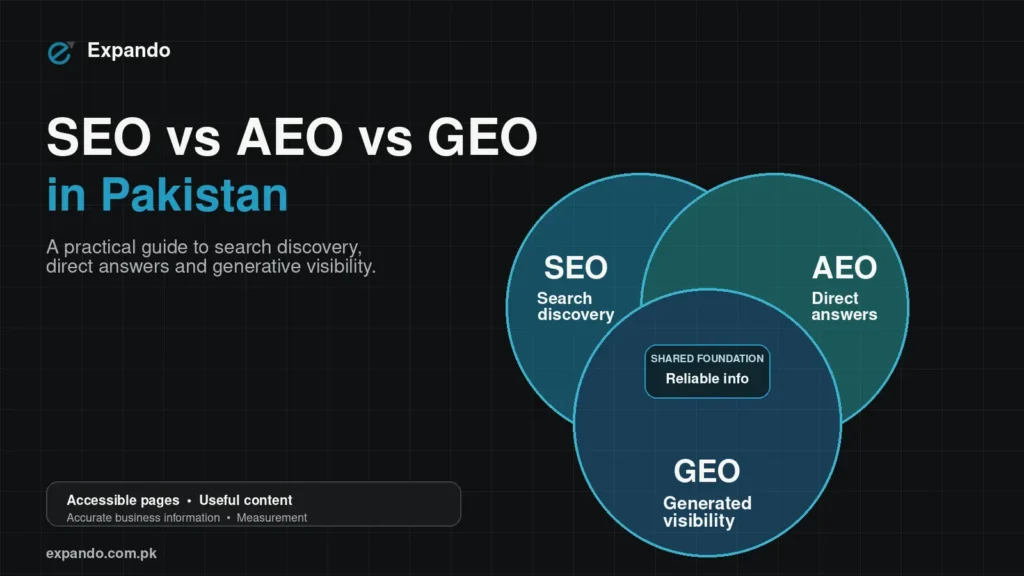
SEO, or search engine optimization, addresses discoverability in search engines. AEO, or answer engine optimization, emphasizes clear answers to questions. GEO focuses on visibility in generative responses. GEO complements SEO rather than replacing it. Their practical work overlaps: accessible pages, understandable information, and credible evidence. Using AI to write advertisements or blog posts is a separate activity; it does not by itself establish GEO visibility.
The GEO research paper by Aggarwal and colleagues, accepted at KDD 2024, studies visibility in an experimental evaluation framework. It also describes publishers’ limited control over how generated answers use their content. That research provides context for the term, not evidence of revenue gains for Pakistani SMEs.
How can GEO help a small business in Pakistan?
GEO work can support clearer business information and more useful customer research when relevant sources are discovered and used. Its value depends on the question, the information available, and whether the customer takes a meaningful next step.
More accurate descriptions: a supplier with a clear capabilities page gives people a factual account of its services, materials, and limitations. Correcting an outdated product or service description is useful even when an AI system does not reference the update.
Visibility during comparisons: a buyer researching delivery options, service coverage, or procurement requirements needs specific answers. A page explaining those details may be useful during that comparison, although the business cannot control which sources an AI system selects.
Better evidence of suitability: verifiable qualifications, documented specifications, and transparent processes help buyers decide whether an offering fits. An AI mention should not be presented as an endorsement or proof of quality.
Reusable improvements: accurate contact details, clearer product pages, and working enquiry routes also help people arriving through other channels. Evaluate that practical benefit alongside any observed AI visibility, without assigning every improvement in sales to GEO.
What does this look like for different businesses?
The useful information depends on the decision a customer is making. The following examples are hypothetical illustrations, not observed search queries, verified customer demand, or Expando client results.
| Business type | Example customer question | Information to improve | Useful customer action to measure |
| Clinic | How do I book a consultation at a clinic in Lahore? | Verifiable qualifications, actual location, services, appointment process | Relevant appointment enquiries |
| Ecommerce brand | Does this desk fit my space, and can it be delivered to Karachi? | Dimensions, current price/stock when known, delivery limits, returns | Product engagement and completed purchases where trackable |
| Local service provider | Can a repair provider visit my area in Karachi? | Actual coverage, service scope, process, working contact details | Relevant calls or WhatsApp enquiries |
| B2B firm | Can this supplier meet our packaging specifications? | Capabilities, supporting evidence, procurement requirements, enquiry process | Qualified quotation requests |
The common priority is decision-making information. A clinic enquiry, product purchase, service request, and supplier quotation need different evidence and should be measured separately.
Practical GEO foundations to improve first
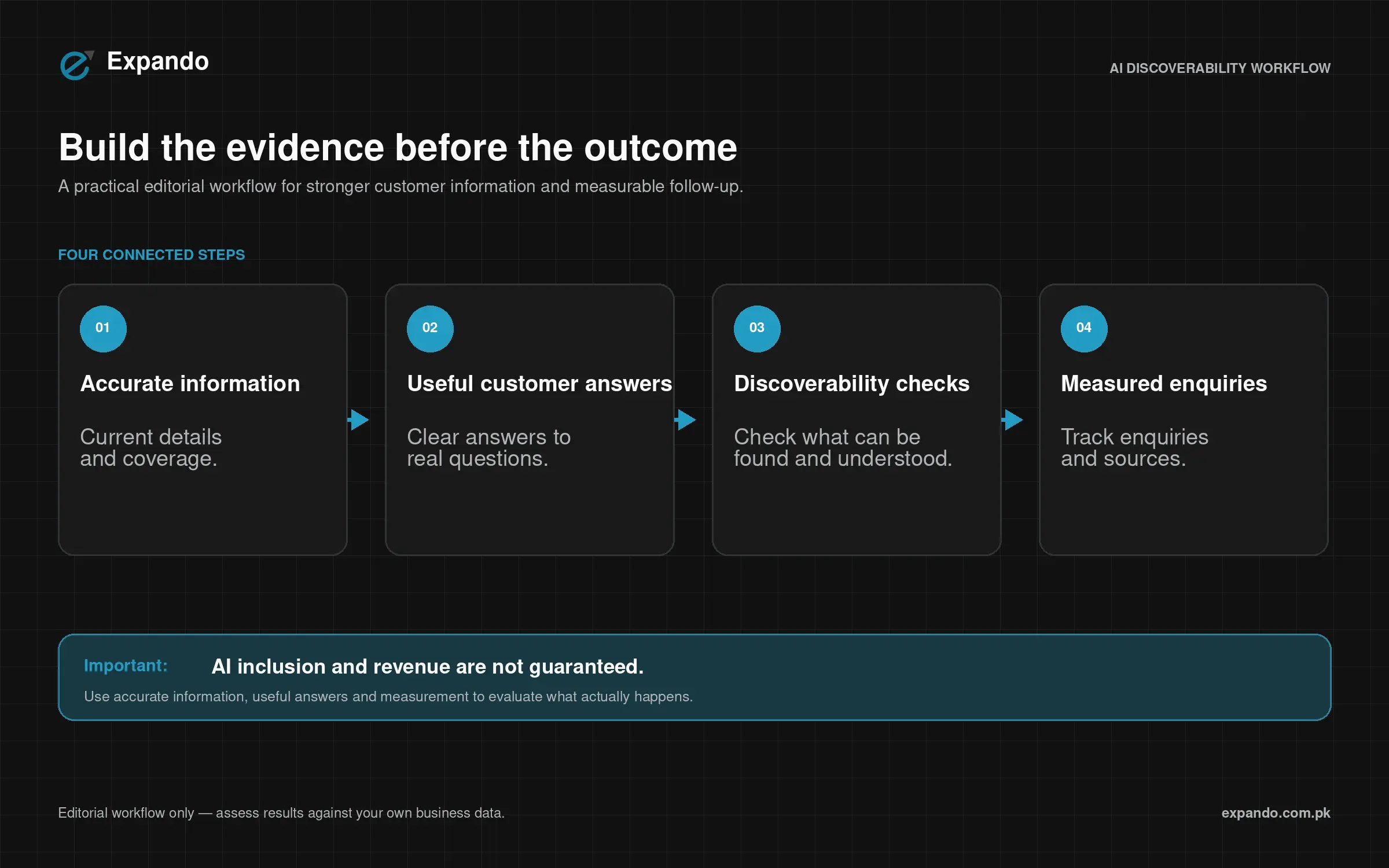
Start with reliable facts and a functioning website, then improve the pages most relevant to customer decisions. The sequence below is editorial implementation guidance based on those dependencies, rather than a universal formula for AI selection.
- Confirm the business facts. Record the real trading name, services, contact details, opening hours, and actual service areas. Identify who can approve changes. A Karachi-based provider should describe its true coverage rather than imply a Lahore office or nationwide service it does not offer.
- Check website access and usability. Ask a developer to investigate blocked pages, broken links, or important information that customers cannot read. For Google’s AI supporting links, pages must be indexed and snippet-eligible; inclusion is not guaranteed. Google’s technical guidance also says no special AI schema or extra machine-readable file is required.
- Improve the most valuable service or product pages. Explain what is offered, who it suits, material limits, and the next step. For ecommerce, maintain specifications, delivery terms, returns, and prices or stock information where available. Remove outdated claims instead of adding more promotional text around them.
- Answer actual customer questions. Use enquiries received by phone, WhatsApp, email, or sales staff to identify uncertainty. Put the answer on the relevant page: installation requirements on a service page, for example, or compatibility details on a product page. Keep personal customer information out of published examples.
- Add evidence that can be checked. Publish genuine qualifications, documented capabilities, relevant examples with permission, and the conditions behind claims. A clinic should verify practitioner details and describe services clearly without inventing credentials or treatment outcomes. Remove any assertion the business cannot substantiate.
- Reconcile public business details. Entity consistency means that relevant sources describe the same real business identity and material facts. Wording need not be identical everywhere. Correct conflicting phone numbers, outdated services, and inaccurate locations; do not manufacture addresses, duplicate location pages, or submit the business to directories in bulk.
- Maintain genuine feedback and relevant mentions. Invite honest customer feedback without buying reviews or inventing quotes. Pursue third-party coverage only where it has a real audience or business purpose, such as a relevant trade association. Keep reviewing your own pages when services, terms, or contact arrangements change.
If structured data is appropriate, keep it aligned with visible facts. Google explicitly requires that consistency; adding markup is not a promise of an AI citation. Treat technical markup as support for accurate pages, with implementation checked by someone who understands it.
A clearer service description
Hypothetical before: “Pakistan’s best maintenance company with guaranteed results.”
Hypothetical after: “[Business name] provides [specific maintenance service] for [customer type] in [actual service areas]. The work includes [verified scope], with [material exclusions]. Send [required details] through [working contact route] to request an assessment.”
Replace the placeholders with approved facts before publishing. The revision explains the offer, audience, area, and next step; it does not demonstrate that an AI system selected the page.
What should an owner with limited time or budget prioritize?
Focus on one important customer journey before expanding the work. A small business can begin by correcting facts and improving an existing page without purchasing a specialist visibility tool.
- Correct material errors in services, phone numbers, prices, or coverage.
- Improve the page closest to a valuable enquiry or purchase.
- Collect recurring customer questions and answer the most decision-relevant ones.
- Test the mobile form, phone link, and WhatsApp route from the customer’s perspective.
- Save a baseline of page performance and enquiry quality before making further changes.
The owner or team should supply approved facts, common questions, actual service boundaries, and a definition of a suitable lead. A developer or specialist may need to investigate indexing, access controls, structured data, or analytics implementation. Assign responsibility for keeping information current after the initial work.
Choose the next task based on the largest obstacle. If a phone number is wrong, correct it before commissioning more articles. If buyers repeatedly ask about delivery restrictions, clarify those terms on the product pages. These changes can improve the customer experience even if no AI citation follows.
How can you measure whether the work helps?
Measure observed AI visibility, attributable website engagement, and qualified business outcomes separately. This prevents a mention or contact-button click from being reported as a sale.
1. Observe a repeatable sample of AI answers
Choose a small set of relevant customer research questions, using genuine enquiry themes where possible. Record the exact wording, platform and mode, language, date, cited sources, and whether the answer describes the business accurately. Include English, Urdu, or Roman Urdu questions only where they reflect your customers’ needs.
Repeat the same sample and log changes rather than selecting only favorable answers. If a response omits the business, note the sources it used and any information gaps worth investigating. This is a diagnostic sample, not a measure of total market share or a stable ranking.
2. Check identifiable website engagement
Where analytics identifies an AI referral, review the landing page and subsequent activity. Keep unidentified visits separate, because referral information can be incomplete. Google reports AI-feature activity within Search Console’s overall Web performance data; that total is not a dedicated GEO segment. See Google’s measurement guidance.
Record page changes alongside other marketing activity. A rise in overall search visits could coincide with promotions, seasonal demand, or other site improvements; it cannot automatically be credited to GEO.
3. Validate enquiries and sales
Define events carefully: a phone-link click, form submission, or WhatsApp contact start signals intent, while a confirmed relevant enquiry requires follow-up. Record whether the customer needed an offered service, fell within actual coverage, and progressed to a quotation, booking, or purchase.
Compare identifiable referrals and landing-page activity with enquiry or sales records where the connection is available. Ask customers how they found the business without treating self-reported answers as complete attribution. When evidence is missing, report the outcome as unattributed rather than calculating a speculative GEO return.
When is professional GEO or SEO support useful?
Professional support is useful when technical access, unclear service content, conflicting public facts, or unreliable tracking prevents progress. Define the problem before choosing a broad package.
Ask for concrete deliverables: an access and indexing diagnosis, prioritized page revisions, a business-information correction list, a measurement plan, and clear implementation ownership. Agree which changes the provider will make, which facts your team must approve, and how completed work will be checked.
Compare proposals by scope and evidence. A useful report distinguishes completed improvements, sampled AI observations, identifiable visits, and qualified enquiries. Treat guaranteed AI recommendations or unexplained visibility scores as a reason to ask for the underlying method.
Expando’s SEO and AI-search visibility services describe support across technical SEO, content, local information, and measurement. Discuss which specific work addresses your business’s current obstacles before committing to an ongoing engagement.
Start with one page and one measurable next step
Choose a revenue-relevant page, correct its facts, answer an unresolved customer question, and test the contact route. Record the starting point and assess qualified enquiries alongside any observed AI visibility. To discuss priorities and implementation responsibility, contact Expando with your website, target customers, and the problem you want to solve.
Pakistan mein GEO business ki madad kaise karta hai?
GEO can help small businesses in Pakistan make accurate, useful information easier to discover and reference during AI-assisted research. Start with clear service or product pages, consistent business facts, relevant customer answers, and evidence that can be checked. Review sampled AI visibility, identifiable website visits, and qualified enquiries separately. These improvements cannot guarantee that an AI system will mention or recommend the business, or that visibility will produce sales.
Frequently asked questions
Does GEO replace SEO for a small business?
No. GEO work overlaps with established SEO foundations such as accessible pages, useful information, and accurate business details. Google confirms that existing SEO practices remain relevant to its AI features, so treat GEO as part of a coordinated plan rather than a replacement.
Can a small business start GEO without expensive tools?
Yes. Begin by correcting business facts, improving a valuable service or product page, answering real customer questions, and testing contact routes. Keep a small, repeatable record of relevant AI answers and available enquiry data; paid monitoring tools are optional rather than a prerequisite.
Does GEO guarantee that AI tools will recommend my business?
No. Improving your information cannot guarantee that an AI system will select, cite, or recommend the business. A mention is also different from a website visit or qualified enquiry, so assess these outcomes separately and avoid guaranteed-placement promises.
How soon can a small business see results from GEO?
There is no dependable fixed deadline for an AI mention, website visit, or qualified lead. Correcting a factual error and observing a change in an AI answer are different outcomes, and the latter remains outside the publisher’s control. Record the starting point, track completed improvements, and review visibility and business outcomes without promising a set number of days.