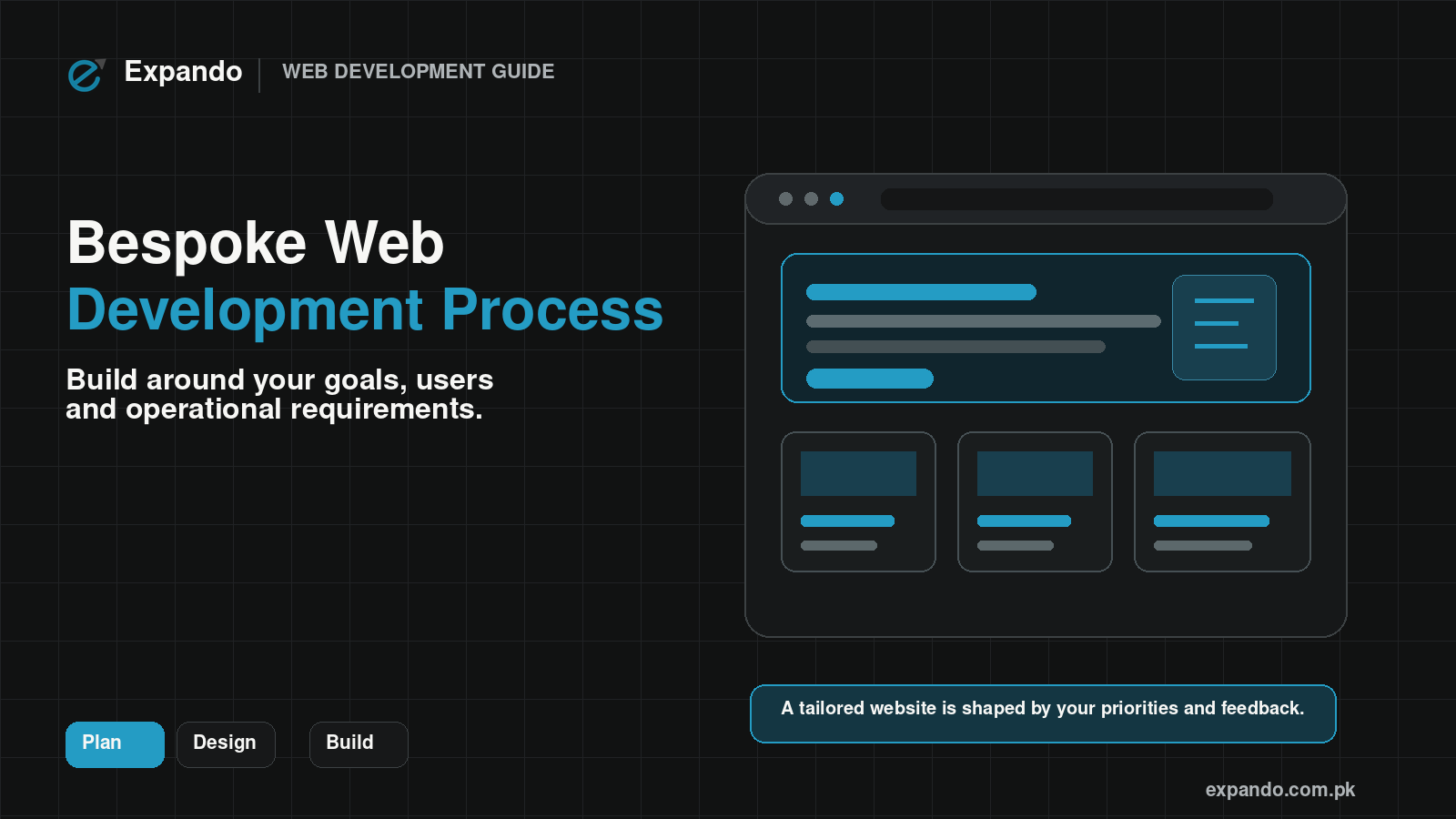
A bespoke website is planned around a business’s requirements and delivered through discovery, agreed scope, design, development, testing, and launch with handover. In Pakistan, the client’s operational knowledge, content, and review decisions help shape that process. Delivery time and cost depend on the agreed functionality, connections to other systems, content readiness, and approvals.
A useful project plan makes progress reviewable: each stage has an output, an owner, and a decision. The roadmap below is recommended practice to agree with a provider, rather than a fixed delivery model or a list of contractual inclusions.
What does bespoke web development mean?
Bespoke web development tailors a website’s experience or functionality to defined requirements. It goes beyond installing a ready-made template unchanged, but it can still use an existing content management system (CMS), framework, components, and external services. A CMS lets authorized staff manage website content.
Custom design concerns how pages look and behave; custom functionality concerns what the website enables people to do. A branded marketing site and a customer portal with different user roles therefore need different scope discussions.
A standard content-led site may be well served by a configured CMS or template. More specific workflows, content structures, or system connections may justify additional custom development. Compare the editing experience, implementation effort, maintenance responsibilities, and limitations before choosing; bespoke work is not automatically faster, safer, or better value.
What are the stages of a bespoke website project?
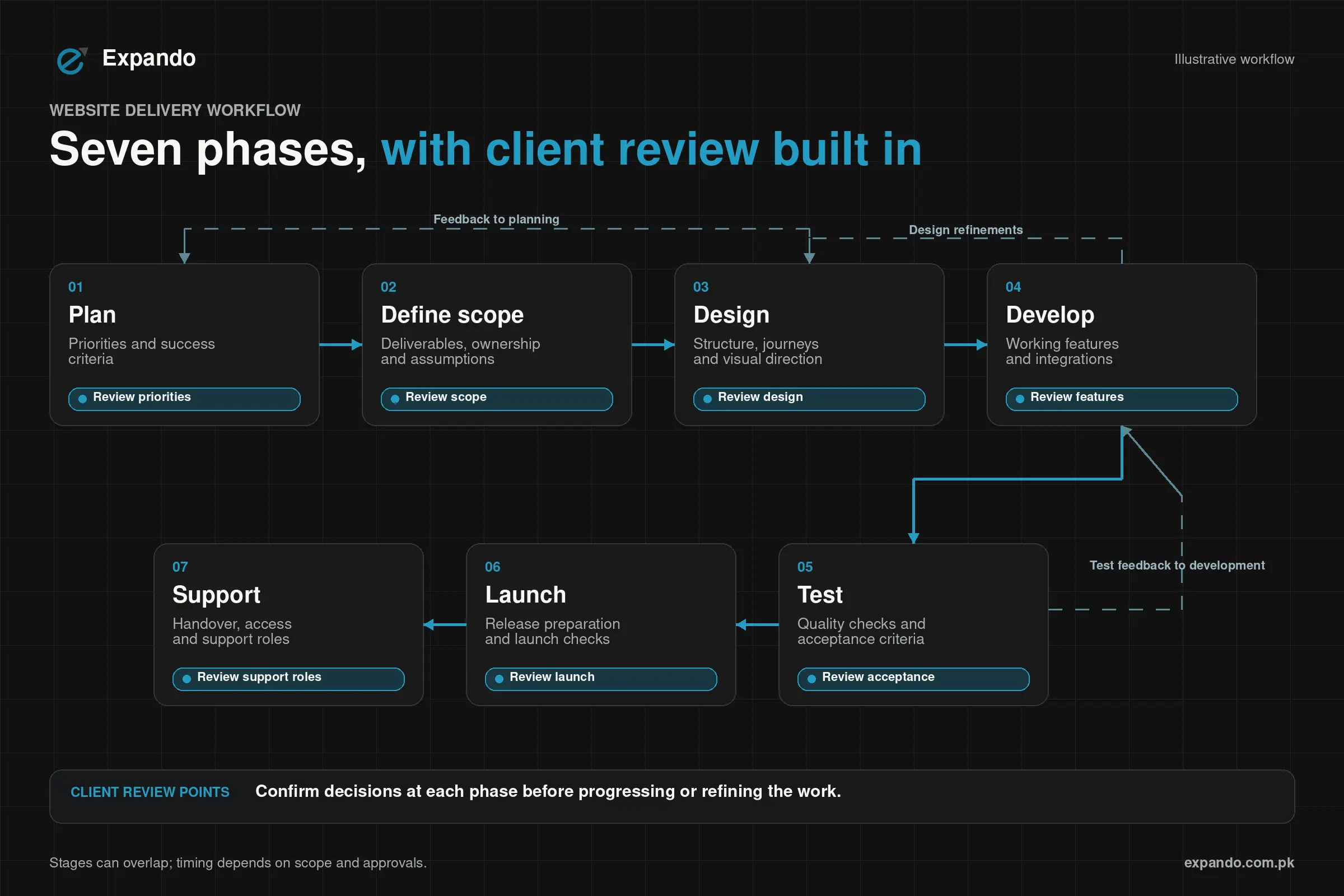
A well-scoped project moves from understanding the business problem to agreeing, building, and accepting a solution, then operating it after launch. This seven-stage roadmap identifies typical outputs and review points; content work, testing, and feedback can overlap and require iteration.
| Stage | Typical output | Client review or approval |
| Discovery | Prioritized needs, journeys, sitemap, content inventory | Confirm the business problem and priorities |
| Scope and technical planning | Agreed scope, acceptance criteria, responsibilities, delivery plan | Approve launch scope, exclusions, and change handling |
| Experience and interface design | Page patterns, responsive layouts, key interaction states | Approve journeys and designs with consolidated feedback |
| Development and integrations | Working features and planned content in staging | Review demonstrations against scope |
| Quality and acceptance testing | Test evidence and prioritized issue list | Confirm business acceptance and unresolved issues |
| Launch and handover | Live-site checks, access record, documentation, recovery plan | Authorize launch and confirm operational control |
| Post-launch support | Agreed issue, maintenance, and renewal arrangements | Confirm support boundaries and future-work process |
Use these review points to confirm decisions before dependent work proceeds. They are not calendar promises, and a complex application may revisit design or planning as requirements become clearer.
1. Discovery: agree the business problem and user journeys
Discovery should establish what the website needs to achieve and how users will complete important tasks. Start with the audience, business goals, current-site problems, and essential workflows before selecting technology.
Explain real operations: who handles enquiries, what information a quotation needs, or who approves a customer account. Gather existing pages, brand assets, content, and stakeholder input. Identify conflicting expectations while they can still be resolved in the brief.
Typical outputs are discovery notes, prioritized needs, an initial sitemap, key user journeys, and a content inventory. A sitemap outlines the planned pages; user journeys describe the steps people take to reach an outcome.
The client should nominate a decision-maker and confirm the problem and priorities. Approval means the team agrees what matters most, rather than simply agreeing that a new website is needed.
2. Scope and technical planning: turn needs into a reviewable brief
Scope should turn business needs into defined pages, features, responsibilities, and acceptance criteria. An acceptance criterion is a testable condition for deciding whether an agreed requirement has been met.
Specify user roles, CMS editing needs, integrations connections between the website and other systems and any content or data migration. Separate essential launch functionality from later enhancements. Record assumptions, exclusions, external dependencies, milestone reviews, and how changes will be assessed.
Hypothetical acceptance criterion: when a visitor submits a valid enquiry form, the page shows confirmation and the nominated business recipient receives the test enquiry. Invalid input produces clear guidance so the visitor can correct it. That is more reviewable than “the form should work well,” but it does not cover every security or privacy requirement.
The output should be an agreed scope or prioritized feature list and delivery plan. The client approves what is included, who supplies each item, and how completion will be checked. Confirm content-writing responsibilities rather than assuming the developer will create all copy.
When reviewing Expando’s web development services in Pakistan, use your agreed requirements as the basis for a project-specific proposal. Request written confirmation of deliverables and exclusions instead of treating a service-page description as the final scope.
3. UX and UI design: approve the experience before visual polish
User experience (UX) concerns how people navigate and complete tasks; user interface (UI) concerns the screens and controls they use. Review key journeys and page structure before concentrating on colors or decorative detail.
Typical design outputs include wireframes – simple layout plans – branded page patterns, responsive layouts, and prototypes where useful. Review important states such as empty results, validation errors, and confirmation screens, as well as the ideal journey.
Supply real content and brand assets so the team can assess meaningful headings, image needs, and editing requirements. Consolidate stakeholder feedback through the nominated decision-maker. Approve the page patterns and interactions that development will follow.
Include accessibility review during design and continue it through the build. W3C’s accessibility-evaluation overview recommends checking early and throughout development, rather than treating accessibility as a final scan.
4. Development and integrations: build and review working features
Development turns approved designs and requirements into working pages and functions. The frontend is what visitors interact with; the backend supports functions such as saving information, managing content, or applying user permissions.
Use a staging environment, a separate review version of the site and demonstrations suited to the project’s complexity. Check working features against the scope and record decisions. Technology selection should follow requirements; a bespoke project does not need every available framework.
Plan content population and migration as delivery tasks with assigned owners. Review transferred text, images, records, and page relationships against the agreed inventory. A working layout with missing or unapproved content is not the same as a launch-ready page.
For a Pakistani business, ask whether the project needs PKR display, Urdu or multilingual content, right-to-left layouts, payment or courier connections, or WhatsApp enquiry flows. These are optional requirements to validate. Check provider documentation and commercial eligibility before promising a particular integration, fee, or onboarding duration.
For store-specific planning, Expando’s ecommerce website development guide provides related context; keep catalogue, payment, and delivery requirements explicit in the project scope.
Expando’s web development service describes CMS implementation and external-system connections. Confirm the specific integration, content-loading, and deployment work in your proposal, and agree how new requests affect effort and the delivery plan.
5. QA and UAT: demonstrate that the agreed journeys work
Quality assurance (QA) covers the delivery team’s checks; user acceptance testing (UAT) lets the client confirm that the agreed business journeys work. Use documented requirements and an issue list to make that decision reviewable.
Agree appropriate browser and device coverage, responsive-layout checks, content review, and tests for forms, permissions, performance, and integrations. Test unsuccessful actions and error messages as well as successful submissions. An operational application needs testing proportionate to its data, roles, and risks.
Automated accessibility tools can assist, but W3C states that tools alone cannot establish whether a site meets accessibility standards; knowledgeable human evaluation is needed. Request evidence of the agreed checks rather than accepting a scan as certification.
Agree a proportionate security review with a qualified practitioner, using a reference such as the OWASP Web Security Testing Guide to scope the work. HTTPS, a plugin, or a quick scan should not be described as complete security or a hack-proof guarantee.
A defect fails an agreed requirement; a new or altered requirement may be a change request. Confirm the classification, priority, and any scope effect in writing. Record unresolved issues and who accepts the launch decision. Acceptance should refer to agreed requirements, rather than “everything is perfect” or an arbitrary tool score.
6. Launch and handover: agree readiness, access and recovery
Launch should be an agreed operational decision with readiness checks, responsible people, and a recovery plan. Handover should explain how the business will manage the website and obtain support after the delivery team steps back.
Agree a go-live checklist covering production settings, approved content, backups, recovery responsibilities, live journey tests, and monitoring. Identify who can authorize launch and who will respond if a critical journey fails. Test the live enquiry or purchase route after deployment rather than assuming staging results are sufficient.
If an existing site’s URLs change, plan old-to-new page mapping, relevant redirects, and updated internal links. Update canonical references, which identify preferred page URLs, and sitemap references, then test and monitor the move. Google’s site-move guidance covers these migration steps and warns that search rankings may fluctuate. These tasks are conditional on the rebuild; a completely new site does not need redirects merely because it is launching.
The handover record should clarify control of the domain and hosting accounts, CMS access, relevant code or repository access where contracted, third-party licenses, documentation, training, renewals, and support contacts. Identify both the business account owner and the person managing each service.
Ownership and portability depend on the agreement and platform terms. Clarify what is transferred, what is licensed, and what access is available if the relationship ends. Arrange controlled account access; keep passwords and other sensitive credentials out of shared briefs and handover prose.
7. Post-launch support: distinguish fixes, maintenance and future work
Post-launch arrangements should separate correction of agreed defects from ongoing maintenance and new development. Define those responsibilities before launch so the business knows how to report an issue and authorize further work.
Agree who monitors important journeys, applies updates, manages backups, handles operational problems, and renews hosting or licenses. State what the support or warranty period covers, how issues are reported, and what falls under a separate maintenance agreement.
An enhancement, such as a new user role or reporting feature, may require fresh scope and approval. Do not assume unlimited support or that routine maintenance includes every future feature.
What affects cost and delivery time in Pakistan?
The estimate depends on the work and its dependencies, not simply whether the project is called bespoke. A scoped proposal should explain the design effort, functionality, integrations, content, migration, testing, and client decisions behind the estimate.
Page variations and complex user journeys can require different effort from repeating an approved page pattern. Existing data may need preparation before migration. Missing copy, conflicting stakeholder feedback, external account approvals, or changes after sign-off can alter the delivery plan.
Separate the one-time build from hosting, domain renewals, licenses, third-party charges, and maintenance. Ask who pays each external cost, who manages the account, and whether ongoing work is included or separately quoted.
If an external deadline matters, share it during discovery and distinguish essential launch scope from later improvements. Ask the provider to explain assumptions and dependencies in the estimate. A standard PKR price or fixed week-by-week promise would not capture those project-specific decisions.
What should you prepare before contacting a developer?
Prepare enough business information to make the first scope discussion concrete. A complete technical specification is not necessary, but the developer needs to understand your priorities and constraints.
- Business objective and target users: what the website should help people do.
- Existing website and priority journeys: what to retain, fix, replace, or migrate.
- Must-have features and integrations: the essential functions and systems involved.
- Branding and content: available assets, who owns them, and who will supply missing material.
- Budget range and deadline constraints: what is flexible and what depends on an external event.
- Decision-maker and feedback process: who consolidates comments and approves milestones.
- Account owners: who controls the existing domain, hosting, and relevant services; arrange controlled access separately.
- Handover and maintenance expectations: editing needs, training, access, renewals, and ongoing responsibilities.
Bring business facts and ownership information, rather than passwords. Flag unknowns so discovery can resolve them instead of allowing assumptions to become unplanned work.
Start with a clear scope and shared responsibilities
A useful bespoke web development process makes decisions, deliverables, and acceptance criteria visible. Confirm the business problem, approve the scope, review working journeys, and agree who controls and maintains the website after launch.
Share your goals, required functions, existing website, and content readiness through Expando’s web development page to discuss requirements and request a proposal. Its proposal form and WhatsApp route provide enquiry options; the resulting plan should reflect your project’s actual dependencies.
Pakistan mein apni zaroorat ke mutabiq website banwane ka tareeqa kya hai?
In Pakistan, a bespoke website project should start with business goals, user journeys, and an agreed scope. The team then designs the experience, develops the approved features and integrations, tests the agreed requirements, and prepares launch and handover. The client supplies accurate content and consolidated approvals, while the agreement defines access, ownership, and ongoing support. Cost and delivery depend on scope, external dependencies, content readiness, and changes.
Frequently asked questions
Can a bespoke website use WordPress or another CMS?
Yes. Bespoke development can tailor the design, content structure, and functionality while using an existing CMS such as WordPress. Ask which parts will be customized, what your team can edit, and which licenses or third-party services remain necessary.
How long does bespoke web development take in Pakistan?
There is no single delivery time for every bespoke project. The estimate depends on functionality, integrations, content and migration, testing, and the client’s approval process. Request a milestone plan that states its assumptions and dependencies, and identify essential launch features separately from later enhancements.
What happens if requirements change during development?
Record the request and ask the provider to assess its effect on scope, cost, dependencies, and delivery before approving it. A feature that fails an agreed requirement is a defect; a new or changed requirement may be a scope change. Keep the decision and revised acceptance criteria in writing.
Who should control the domain, hosting and website access after launch?
Clarify business control of the domain and hosting accounts, CMS access, renewals, and support responsibilities in the agreement. Source-code or repository access and third-party licenses depend on the contracted terms and platform. Request a handover record explaining what transfers, what remains licensed, and how authorized access will be maintained.