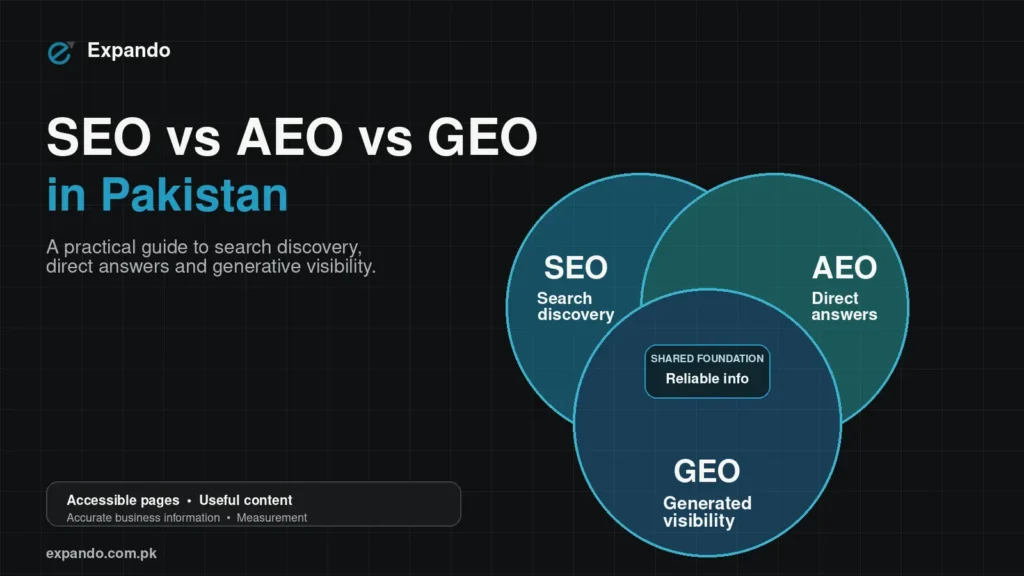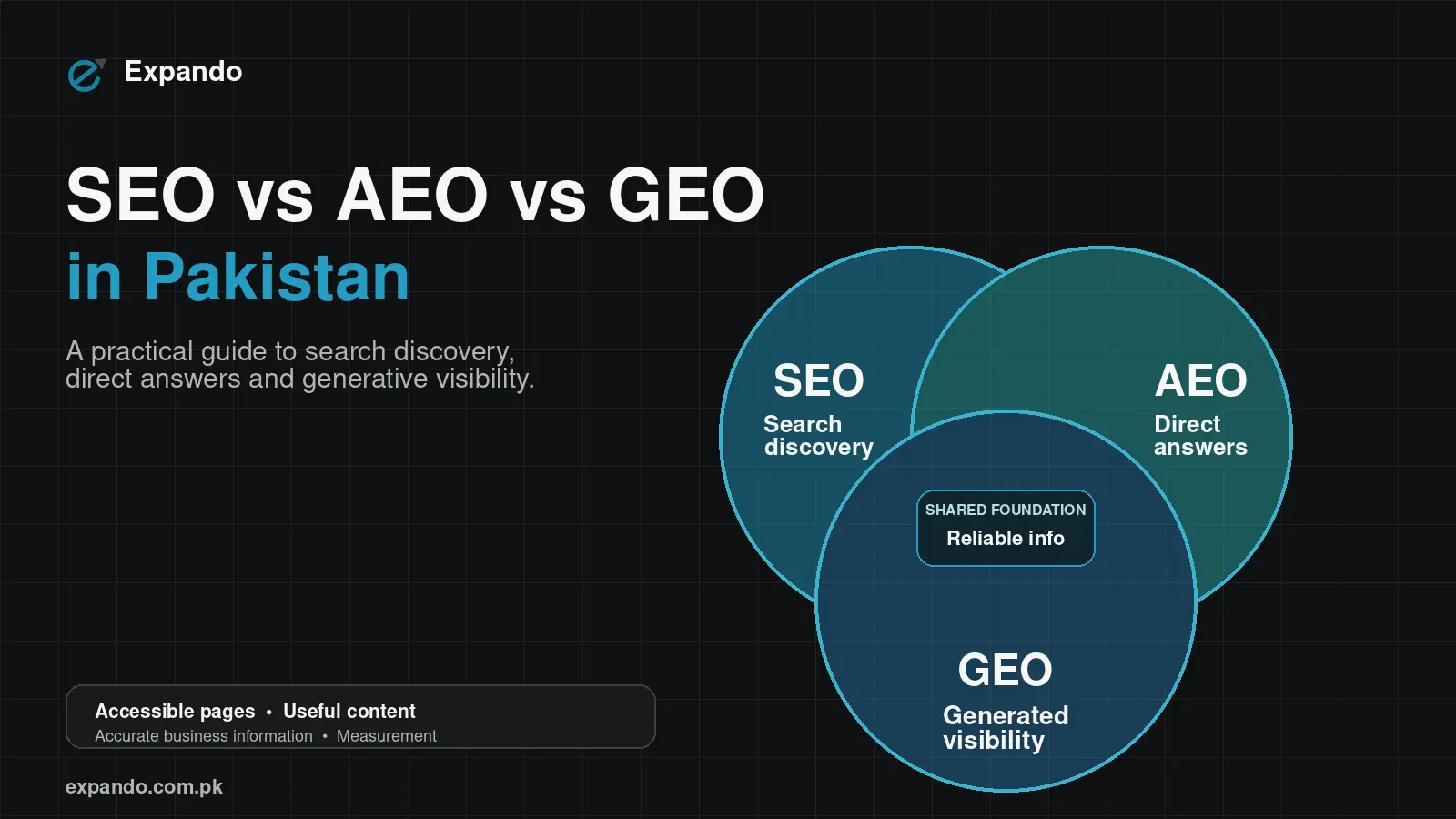
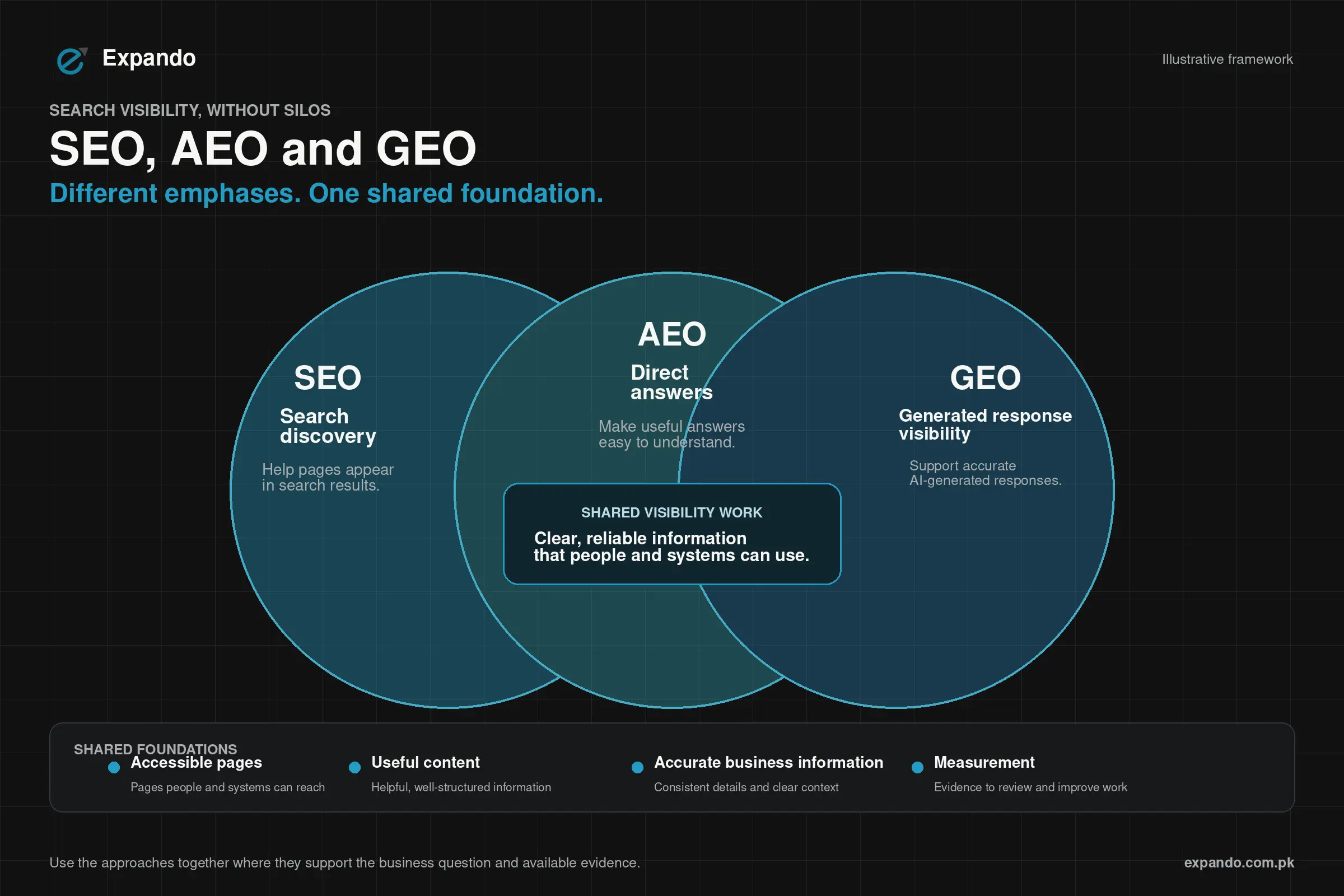
SEO improves discoverability in search, AEO emphasizes clear answers to specific questions, and GEO focuses on visibility and accurate representation in generated responses. For businesses in Pakistan, these approaches overlap and should support customer needs and measurable business goals on a sound SEO foundation. Prioritize the work your website needs rather than treating each acronym as a separate campaign or a guarantee of placement.
When comparing proposals, ask what will change on your website, which buyer questions the work addresses, and how progress will be assessed. The labels become useful when they describe concrete responsibilities.
What do SEO, AEO and GEO mean?
SEO, AEO and GEO describe different emphases within discovery and content work. The definitions below are practical working distinctions; usage varies, and the acronyms are not universal platform standards or certifications.
SEO: Search Engine Optimization
Search Engine Optimization helps search engines understand content and helps people find and evaluate relevant pages. Google’s SEO Starter Guide describes that broader purpose; SEO involves more than placing keywords in a page.
For example, an ecommerce business might improve its category structure, product descriptions, page titles, and links between related pages. Indexing means a search engine has processed a page into its searchable index; eligibility and ranking still require attention, and no tactic automatically produces first place.
AEO: Answer Engine Optimization
Answer Engine Optimization emphasizes answering a specific question clearly and usefully. Depending on the question, that might mean a direct explanation, an ordered procedure, or a comparison table on an existing relevant page.
A featured snippet is a search result box that presents the descriptive extract before the page link. Google can also show these extracts in related-question groups, but publishers cannot designate a page as a featured snippet: Google makes the selection. Its featured-snippet guidance explains this limit.
GEO: Generative Engine Optimization
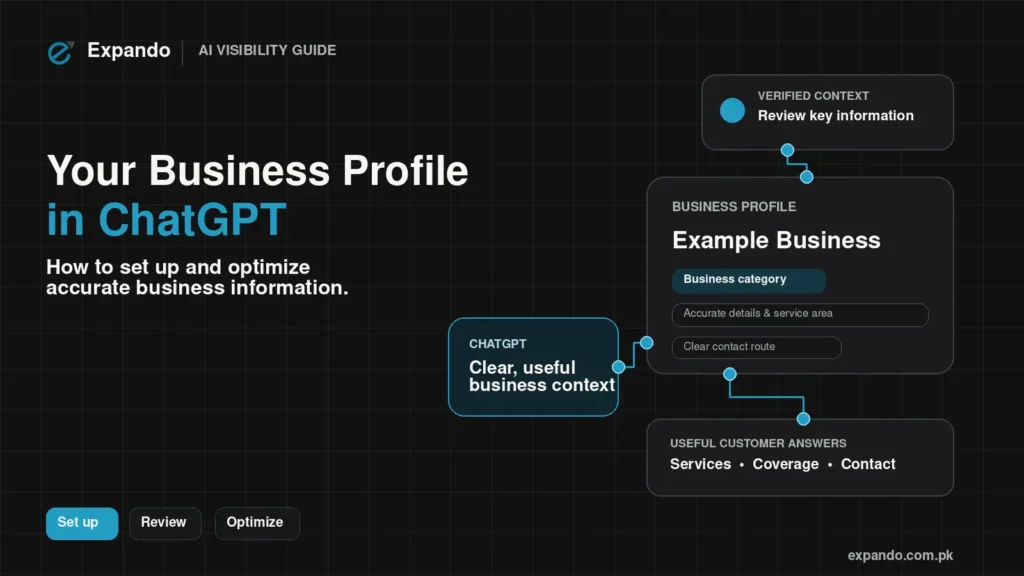
Generative Engine Optimization focuses on source visibility and accurate business information in generated responses. GEO here means generative optimization, rather than geographic targeting. A source citation is a reference to supporting material; it is distinct from a business-directory listing.
The GEO research paper by Aggarwal and colleagues, accepted at KDD 2024, studies visibility in an experimental framework and describes publishers’ limited control over presentation. It is a research context, not a live ranking specification or proof of business revenue gains in Pakistan.
A search engine can offer conventional results, answer extracts, and generated responses, so one page may contribute across those experiences. Google’s generative features remain part of Search. Avoid assuming that every assistant response uses live search, includes citations, or follows the same process as a featured snippet.
SEO vs AEO vs GEO: a practical comparison
Use the table to compare the emphasis of the work, rather than to infer three disclosed ranking formulas. The content and measurement practices overlap; the “key considerations” row describes foundations or editorial recommendations, not verified signal weights.
| Dimension | SEO | AEO | GEO |
| Search surface | Search results and discoverable website pages | Answer-oriented features, including relevant snippets | Generated responses that may reference sources |
| Objective | Help relevant pages be found and evaluated | Answer a specific question clearly | Support source visibility and accurate business representation |
| Content approach | Relevant service, category, product, and information pages | Self-contained explanations, steps, or comparisons | Informative source material, verifiable facts, and context |
| Key considerations / signals | Access, understandable structure, useful content, internal links | Question fit, clarity, accuracy, and appropriate format | Accurate business details, supporting evidence, and contextual relevance |
| Measurement | Search visibility and clicks; landing activity; qualified outcomes | Sampled answer appearances; attributable visits and outcomes where available | Sampled source/brand observations; identifiable referrals; qualified outcomes |
The practical takeaway is to improve the same useful pages for discovery, understanding, and customer decisions. Google AI features sit within Search, and a source mention does not guarantee a website visit.
Why SEO remains the foundation
SEO remains the foundation because accessible, understandable pages are relevant to both search discovery and answer-oriented experiences. AEO and GEO extend that work; they do not replace it or require duplicate versions of every page.
Google’s AI-features guidance says established SEO practices remain relevant to AI Overviews and AI Mode. Supporting-link eligibility requires indexing and snippet eligibility, without guaranteed display. Google does not require special AI schema or an additional machine-readable file for these features.
A useful improvement can address several needs at once. Clarifying a service description helps a buyer understand the offer; putting its scope under a descriptive heading makes the information easier to find. You can make those changes while a developer investigates access problems, rather than waiting for every SEO task to finish.
One page serving several purposes
Consider a hypothetical Pakistani packaging supplier publishing a guide to its actual carton options. The page explains available materials, owner-approved specifications, ordering requirements, and genuine delivery coverage, with links from the relevant product category.
A section directly answers a buyer’s question about which measurements are needed for a quotation. Verifiable specifications provide context that a generated response might reference. The page therefore supports search discovery, a direct answer, and informative source material through shared work. This illustration does not represent an observed ranking, citation, or enquiry result.
If access or page structure is the obstacle, Expando’s SEO services in Pakistan provide a relevant starting point for discussing the foundational work. Ask which problems need correction and who will implement the changes.
Which approach should a business in Pakistan prioritize?
Neither SEO nor AEO is automatically better for every business, and GEO does not remove the need to diagnose current problems. Prioritize material access issues, gaps in buyer information, relevant search experiences, and the customer action the business wants to enable.
Local services: clarify the offer and real coverage
Start with an accurate service page that states what the business does, where it actually operates, and how an enquiry is handled. Add answers to genuine questions about scope, scheduling, or assessment requirements.
For a hypothetical repair provider serving selected Karachi areas, the first improvement could be correcting unclear coverage and testing its mobile contact route. Do not imply a Lahore office or nationwide availability without evidence. Measure relevant calls or WhatsApp enquiries from people needing an offered service within the real coverage area.
Ecommerce: make products easier to evaluate
Start with a valuable category or product page whose information is incomplete or hard to find. Check specifications, current prices or availability where known, delivery limits, returns, and links that help a customer compare relevant options.
A hypothetical furniture seller could clarify dimensions and delivery restrictions before commissioning broader blog content. Answering “Will this fit my space?” helps the buying decision on the product page itself. Measure product engagement and completed purchases where trackable, while investigating whether unclear information continues to generate avoidable enquiries.
B2B firms: explain capability and buying requirements
Start with a capability or service page that explains what the firm can supply, what evidence supports that capability, and what a buyer must provide to request a quotation. Address procurement questions using approved facts.
A hypothetical manufacturer could explain material options, documented specifications, and quotation requirements without inventing certifications or client results. Measure qualified quotation requests that match its actual capabilities. A large volume of unsuitable enquiries would be a reason to clarify the page further, even if visibility increased.
How to combine SEO, AEO and GEO in one plan
Build one plan around business goals and page-level problems, with technical, content, and measurement work coordinated. The following sequence is editorial planning guidance, not a timetable for guaranteed results.
- Set a goal and baseline. Choose a useful outcome, such as suitable service enquiries or product purchases. Record available page performance and current enquiry quality before changing the site.
- Resolve material access and content problems. Investigate blocked or broken important pages, missing information, and conflicting business facts. Assign technical fixes to someone who can implement and verify them.
- Strengthen high-value pages. Prioritize pages closest to an important customer decision. Clarify the offer, suitability, limitations, and next step before adding a large volume of new content.
- Answer genuine buying questions. Draw questions from sales conversations, support requests, and enquiries. Use a direct explanation, table, or procedure where it improves understanding, without adding repetitive FAQ blocks to every page.
- Maintain evidence and business information. Verify specifications, service areas, qualifications, and supporting examples. Reconcile material facts across relevant public sources and assign someone to keep them current.
- Monitor and refine. Check completed changes, repeat selected visibility observations, and review customer outcomes. Adjust priorities when new information reveals a more important obstacle.
Some tasks can run together: an owner can approve service facts while a developer checks access and an editor improves a page. A paid monitoring tool is not required to begin. Allocate resources according to the work needed and the team’s ability to implement it, rather than a universal percentage split across acronyms.
For an external provider, request a scoped list of pages and fixes, named implementation responsibilities, and reporting definitions. Ask whether content revisions, technical deployment, and tracking setup are included. The same page improvement should not be counted as three separate deliverables merely because it supports SEO, AEO, and GEO.
How should you measure progress?
Separate visibility observations from website activity and business value. A page can appear in an answer without producing a visit, while a visit can occur without becoming a relevant enquiry.
Review search and landing-page performance
Use available search-performance data to inspect relevant queries, pages, impressions, and clicks, then examine what visitors do on the landing page. Compare periods thoughtfully and keep a change log so promotions, seasonality, and other site work are not overlooked.
Google includes AI-feature activity within Search Console’s overall Web performance reporting. That total is not a separate AEO or GEO category and cannot, by itself, identify the contribution of each emphasis. Google’s reporting guidance sets this boundary.
Use answer and AI observations as diagnostics
Check relevant answer-feature appearances and maintain a small, repeatable set of AI research questions. Log the date, exact wording, language, platform and mode, cited URLs, and whether the business information is accurate. Use English, Urdu, or Roman Urdu where those languages reflect actual customer needs.
Retain unfavorable observations as well as favorable ones. A changing sample may highlight missing facts or useful sources to examine, but it is not total visibility share or a stable rank. Do not interpret one favorable answer as permanent inclusion.
Connect identifiable activity to qualified outcomes
Referral traffic means visits identified as arriving from another website or service. Where an AI referral can be identified, examine its landing-page activity and connect it to enquiries or sales when the records support that connection.
Define the steps separately: a WhatsApp click starts a contact action; a suitable enquiry requires follow-up; a confirmed lead or sale needs further evidence. An AI citation is not an endorsement, and it does not automatically produce traffic or revenue. Referral and attribution data can be incomplete, so report unknown sources honestly and avoid assigning all growth to AEO or GEO.
Common misconceptions to avoid
Evaluate proposals by the work and evidence behind the terminology. These assumptions can otherwise turn a useful plan into unnecessary activity.
- “SEO is replaced.” Answer and generative work share foundational needs; replacing the label does not fix weak pages.
- “Every acronym needs its own campaign.” Related improvements can belong in one coordinated plan, with shared pages and responsibilities.
- “FAQ markup guarantees an answer.” Google chooses featured snippets, and publishers cannot mark a page into that placement. Formatting is not a selection guarantee.
- “AI SEO always means AI-written content.” Ask the provider to define the work behind that label before approving its scope.
- “A citation proves the campaign worked.” Check identifiable visits and qualified outcomes before claiming business impact.
Choose priorities from your business’s actual gaps
Start with the page or customer journey where clearer information and better access would matter most. Combine discoverability, useful answers, and accurate business evidence in one plan, then judge progress against relevant enquiries or sales.
Explore Expando’s AI-search visibility support through its combined SEO service page, or use the contact form or WhatsApp route to discuss your website and priorities. Ask for concrete deliverables and implementation ownership rather than three separate retainers based only on acronyms.
Pakistan mein SEO, AEO aur GEO mein kya farq hai?
SEO supports discoverability in search engines, AEO emphasizes useful direct answers to specific questions, and GEO focuses on visibility and accurate representation in generated responses. These practices overlap and can improve the same relevant pages rather than requiring separate copies of the content.
For a business in Pakistan, prioritize technical access, clear buying information, verified business facts, and usable contact or purchase routes. Measure visibility separately from visits and qualified customer outcomes.
Frequently asked questions
Is AI SEO called GEO?
“AI SEO” can mean using AI tools during SEO work or optimizing for AI-search experiences. GEO usually describes the latter emphasis on generated responses, but industry usage varies. Ask whether a proposal covers content production, technical improvements, answer visibility, measurement, or a combination before comparing prices.
Does AEO replace SEO?
No. Clear answers still benefit from accessible, relevant pages and sound search foundations. Use AEO to improve how well a page answers a genuine question while maintaining its broader SEO quality; a concise answer does not guarantee a featured snippet or other placement.
Do I need separate pages or special AI schema for GEO?
Do not create duplicate pages solely to give the same content separate SEO, AEO, and GEO labels. For Google AI Overviews and AI Mode, Google’s guidance says no special AI schema or additional machine-readable file is required. Improve the relevant page and confirm the selected platform’s actual requirements rather than assuming one rule covers every AI system.
How can I measure SEO, AEO and GEO without double-counting results?
Separate search and answer-visibility observations from identifiable website visits and qualified enquiries or sales. Google includes its AI-feature activity within Search Console’s overall Web reporting, so that total is not a standalone GEO segment. Keep sampled AI observations separate, and do not count the same recorded lead more than once across reports.