Calculate digital marketing ROI in Pakistan as (C − M) ÷ M × 100, where M is the full marketing cost within your chosen scope and C is attributable net sales minus variable product or service delivery costs, before marketing. This measures contribution earned after marketing relative to marketing spend, rather than total-business investment or net profit after all overhead. Reliable sales, cost and attribution records determine how useful the result is; the PKR examples below show the calculation.
What is digital marketing ROI and how is it different from ROAS?
Marketing ROI asks whether the contribution associated with your marketing covers its costs and leaves a surplus. Contribution is the amount remaining from net sales after variable non-marketing costs, such as product cost and fulfilment. In this guide, that contribution is compared with the full in-scope marketing spend.
ROAS, or return on advertising spend, divides attributed sales value by advertising spend alone. It can help assess paid campaigns, but it omits product costs and other marketing expenses. A strong revenue multiple can coexist with a weak contribution-based return.
Google Ads’ ROI guidance also emphasizes profit and costs, but its worked example divides by combined production and advertising costs. This guide deliberately uses marketing spend as the denominator; compare reports only after checking their definitions.
Other useful metrics answer narrower questions. Cost per lead (CPL) is defined campaign cost divided by valid leads. Customer acquisition cost (CAC) is the defined sales-and-marketing acquisition cost divided by new customers for a matched cohort.
Customer lifetime value (LTV) estimates or observes value across a stated customer relationship period; specify whether it measures revenue or contribution. None of these should be silently substituted for realized marketing ROI.
Which costs and returns belong in your calculation?
Start with a written scope: the campaign or channels, reporting period, customer group and recognition basis. For example, you might assess paid-attributed ecommerce orders from a particular acquisition month after their delivery and return outcomes are known. A calendar-month sales view and a mature acquisition-cohort view answer different questions.
Use net sales and variable delivery costs
Use attributable net sales after discounts, refunds and cancellations. Deduct the relevant cost of goods sold and variable fulfilment, payment or cash-on-delivery charges. For a service business, include variable delivery labour, subcontracting or other costs required to fulfil the sale. The remainder is contribution before marketing, C.
An order placed online is not automatically a paid, completed sale. If a business uses COD, reconcile delivery, payment, failed deliveries and returns with its accounts. State whether the report recognizes sales on an accounting or cash basis and handle taxes consistently with the business’s accounts, including recoverable versus nonrecoverable amounts.
Include the full marketing cost once
M can include ad spend, agency or freelancer fees, creative production, content, attributable staff time and allocated tools. Use a documented allocation method for shared costs so each channel is not charged the entire company software bill. If invoices are in another currency, record the conversion method and date used to express them in PKR.
Do not subtract marketing inside C and subtract it again in the ROI formula. Fixed overhead excluded from this calculation still affects company profitability. Keep late-closing sales and later refunds visible by updating the original cohort or showing a clearly labelled adjustment; avoid moving revenue into a convenient month while leaving its costs behind.
How to calculate digital marketing ROI: a PKR example
The following hypothetical paid-campaign example is a calculation exercise, not Pakistani market data, a benchmark or an Expando client result. Assume all sales are matched to the campaign scope and net of discounts, refunds and cancellations; variable costs and marketing allocations cover the same activity.
|
Hypothetical item |
PKR |
|
Attributable net sales |
500,000 |
|
Variable non-marketing costs |
300,000 |
|
Contribution before marketing (C) |
200,000 |
|
Advertising |
60,000 |
|
Agency and creative |
30,000 |
|
Allocated tools and staff |
10,000 |
|
Total marketing cost (M) |
100,000 |
|
Contribution after marketing (C − M) |
100,000 |
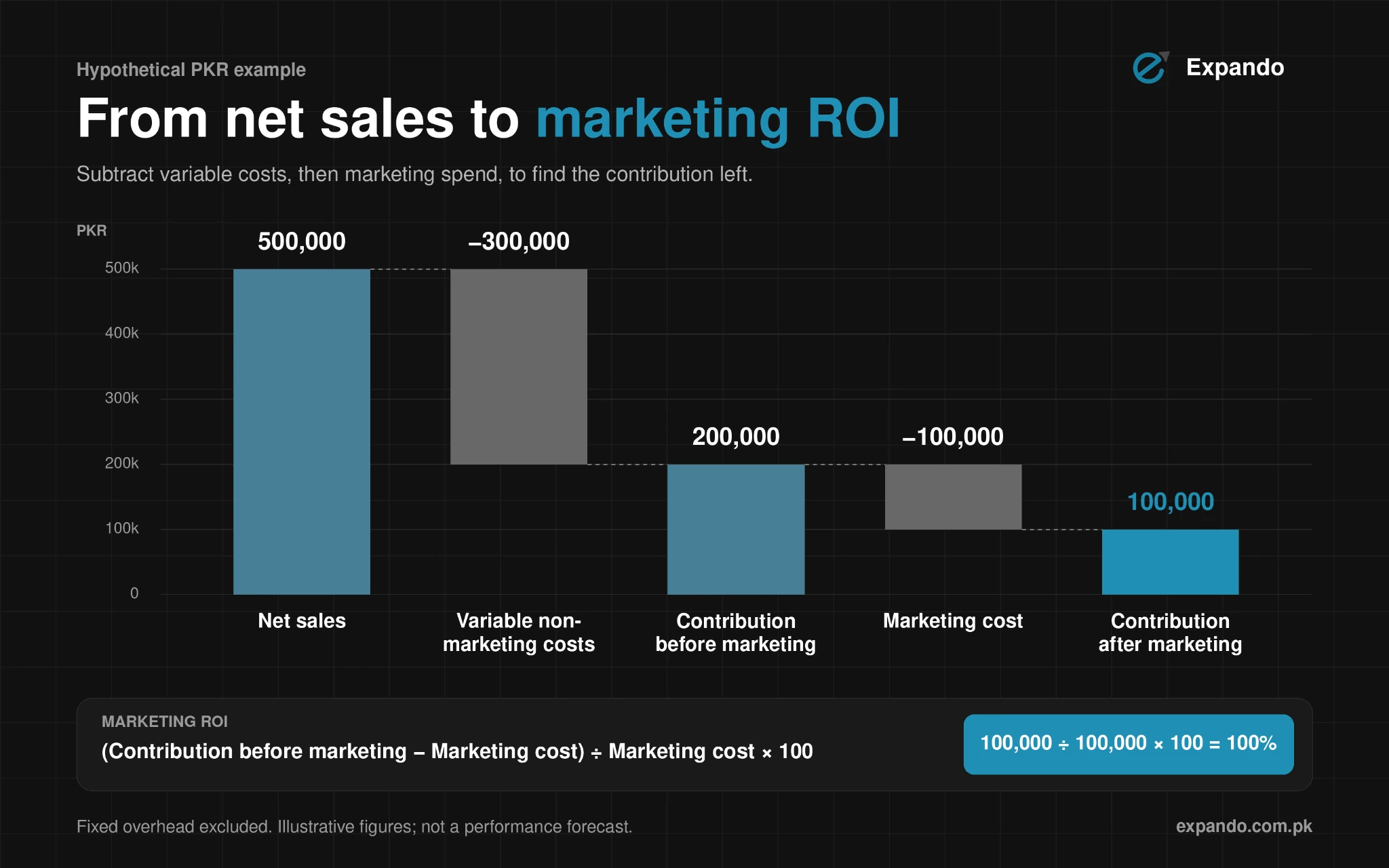
Contribution before marketing: PKR 500,000 − PKR 300,000 = PKR 200,000.
Full marketing cost: PKR 60,000 + PKR 30,000 + PKR 10,000 = PKR 100,000.
Marketing ROI = (PKR 200,000 − PKR 100,000) ÷ PKR 100,000 × 100 = 100%.
Under these assumptions, each PKR 1 of marketing spend leaves PKR 1 of contribution after marketing, before excluded fixed overhead. The PKR 500,000 is sales revenue; it is not profit. If contribution only equals marketing cost, this measure is 0%, meaning marketing break-even within the stated scope.
Compare ROAS on the same sales scope
ROAS = PKR 500,000 ÷ PKR 60,000 ≈ 8.33×. That uses advertising spend alone and ignores the PKR 300,000 variable costs and PKR 40,000 other marketing costs. It is not 733% marketing ROI. A platform’s conversion-value report may also use a different sales definition, so label its result before comparing it with this reconciled calculation.
Calculate marketing break-even sales
Contribution margin before marketing = PKR 200,000 ÷ PKR 500,000 = 40%. If that margin and marketing cost remain unchanged, marketing break-even net sales = PKR 100,000 ÷ 0.40 = PKR 250,000. This is not company-wide break-even: fixed overhead and the stability of the margin assumption still matter. With zero marketing spend, the ROI ratio is undefined; record “not applicable” rather than 0% or infinity.
How do you track ROI across SEO, paid ads, social media and email?
Track the final business outcome alongside the channel activity that preceded it. Sales evidence comes from order, payment and customer records; analytics and campaign systems help assign credit. Keep channel costs and the measurement window consistent with the outcome you report.
|
Channel |
Outcome / evidence |
Costs to include |
Measurement caveat |
|
SEO |
Organic-attributed sales or qualified leads; analytics + orders/CRM |
SEO work, content, technical support, tools |
Sales lag and shared discovery; match horizon |
|
Paid ads |
Matched campaign orders and lead outcomes; ads + CRM/ledger |
Ads, management, creative, allocated tools/staff |
Deduplicate overlapping platform credit |
|
Organic social |
Qualified enquiries and matched sales; tagged links + CRM |
Content, community work, production, tools |
Engagement and clicks are not sales |
|
|
Attributed orders and repeat-customer contribution; tagged links + orders |
Email platform, creative, staff allocations |
Existing customers may have purchased anyway |
Use channel reports to diagnose performance, then reconcile them against one business sales record. Expando’s social media ROI guide and SEO ROI guide discuss channel-specific workflows; apply the contribution and cost definitions above when evaluating profitability.
Value leads without calling them sales
A WhatsApp click, call or form submission is a signal to qualify, not an automatic customer. For a lead cohort with an observed closing rate, estimated contribution per lead = lead-to-sale rate × contribution per won sale. For example, a hypothetical 10% closing rate and PKR 20,000 contribution per won sale imply PKR 2,000 expected contribution per lead before marketing.
That is the estimated pipeline value until the sales close. Use a comparable lead source and enough time for outcomes to mature, then replace estimates with realized results. Do not count both the estimated lead value and its eventual sale. A cheap CPL is only useful if the leads progress to customers with sufficient contribution.
Connect GA4, ads and CRM to actual business outcomes
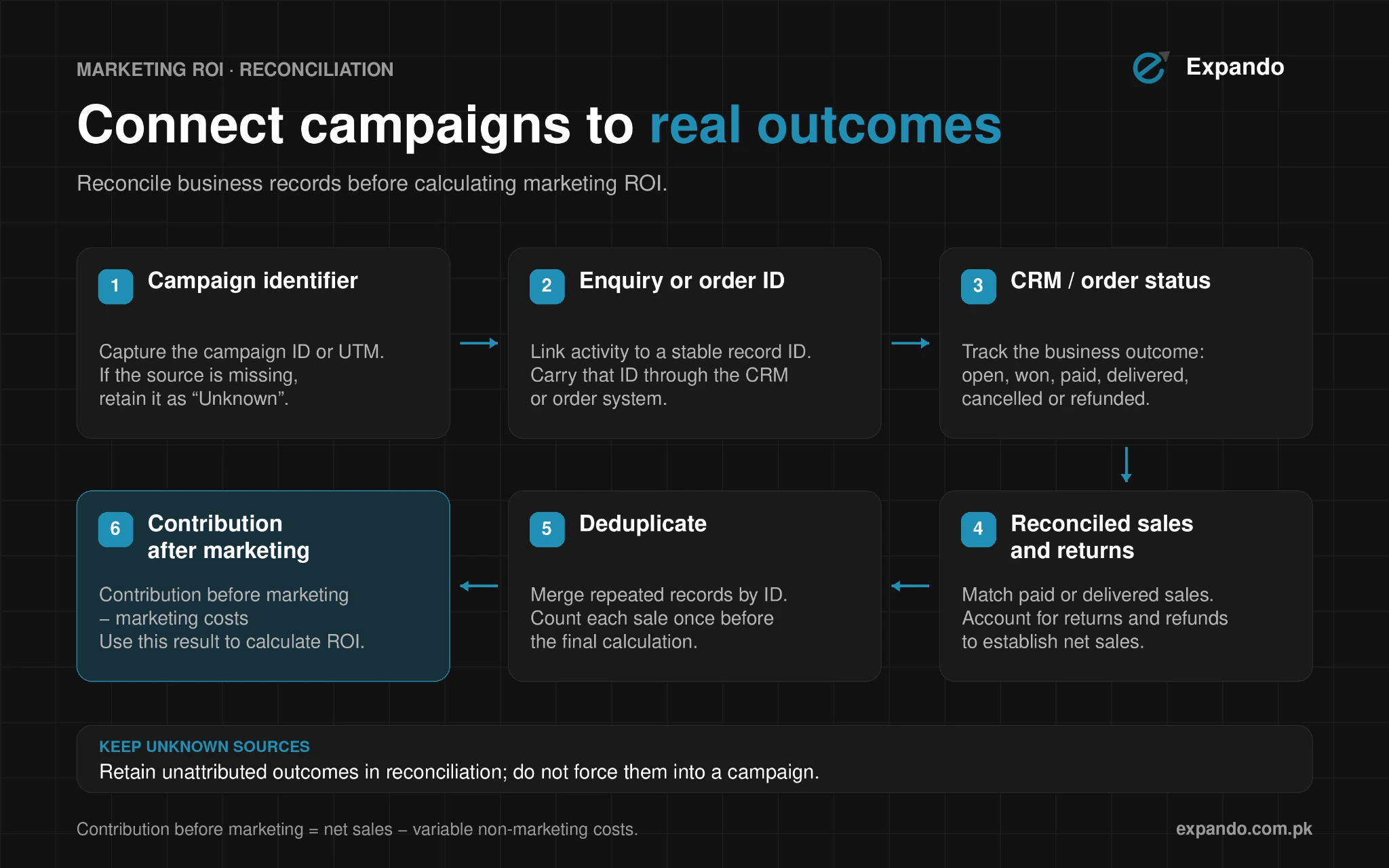
Build a repeatable reconciliation process rather than expecting one dashboard to contain every answer. A CRM, or customer relationship management system, can connect enquiries
and sales stages; even a structured lead register helps if IDs and definitions are consistent.
- Agree on the outcome and window. Define valid leads, new customers, completed sales and the time allowed for conversion. Keep cohort results separate from a simple report of all sales received this month.
- Identify external campaigns. Use consistent campaign names and appropriate UTM parameters for referral, email and social links, alongside supported ad-platform tagging. Google’s URL-builder documentation explains how source, medium and campaign parameters identify referring campaigns in Analytics.
- Verify meaningful events. Test that enquiry actions and purchase records reflect what actually happened, and check value, currency and identifiers against sample orders. Treat a tracked action as evidence of that action; a click to WhatsApp does not confirm a conversation or sale.
- Connect enquiries to records. Capture the available campaign/source information and a unique lead or order ID in your CRM or register. For phone and WhatsApp sales, train staff to record the lead, status and resulting order where feasible. Keep unknown sources visible instead of inventing attribution.
- Reconcile outcomes. Match closed sales, paid or delivered orders, refunds and cancellations to the source records. Deduplicate orders claimed by multiple platforms and retain a single business total. Check the actual recognition basis before applying contribution margins.
- Add costs and review. Allocate marketing invoices, staff time and tools using the agreed scope. Publish the calculation with its window, assumptions and unresolved data gaps, then revisit cohorts whose sales or returns are still developing.
Attribution means assigning credit across interactions; it does not prove that every credited sale was caused by marketing. GA4 currently lists data-driven, paid-and-organic last-click, and Google-paid-channels last-click models in attribution reports. Model settings and conversion windows can produce different credit from ad platforms or CRM records.
When feasible, a planned holdout comparison keeping a comparable group unexposed—can help evaluate incremental results beyond attributed sales. Treat it as a separate causal question, with a suitable design, rather than relabelling ordinary attribution as proof.
Common mistakes that make ROI look better than it is
The largest errors usually come from mixing definitions or counting outcomes twice. Check these before presenting a high percentage as a business result.
Revenue called profit: subtract variable product or service delivery costs before assessing contribution. Ad-only spend called full marketing cost: add the agency, creative, staff and tools included in the scope. Leads given invented values: use observed outcomes for estimates and label the uncertainty.
Overlapping platform credit: one sale can appear in more than one platform, so do not add their totals as unique revenue. Missing refunds or failed orders: reconcile with sales and payment records. Immature leads compared with immediate spend: allow the sales cycle to mature. Forecast LTV mixed with actual sales: keep forecast and realized views separate, with the value basis and horizon stated.
How can you improve marketing returns?
Find the weak part of the calculation before changing the budget. If leads are plentiful but few close, review qualification, response time and the sales process. If sales grow while contribution shrinks, inspect discounts, fulfilment costs, returns and the product or service mix.
If visitors fail to enquire or buy, test clearer offers and a simpler landing-page journey. If lead quality is weak, review targeting and creative against the actual customer need. For repeat purchases, assess retention using observed contribution and an explicit horizon rather than assuming every acquired customer will return.
Test changes against comparable periods or cohorts, accounting for differences in spend, offer and sales maturity. A channel with the highest reported ROAS may have limited scale or lower-margin orders. Increase investment only after checking contribution, capacity and cash requirements, and improve measurement where missing records prevent a credible decision.
Turn the calculation into a decision
Define your scope, reconcile sales and costs, calculate contribution-based ROI, then choose the next test from the weakest stage. Request a free marketing performance assessment from Expando through its contact page, or review its performance marketing support for paid-media and tracking needs.
Pakistan Mein Digital Marketing ROI Kaise Calculate Karein
Calculate marketing ROI on marketing spend as (contribution before marketing minus total in-scope marketing cost) divided by that marketing cost, multiplied by 100. Contribution means attributable net sales less variable product or service delivery costs; marketing cost includes the relevant ads, agency, creative, staff and tools. Reconcile sales, refunds and lead outcomes within a consistent period or cohort, and keep ROAS and forecast customer value distinct from this contribution-based return.
Frequently asked questions
What is a good digital marketing ROI for a Pakistani business?
There is no universal percentage that establishes a good result. Assess the return against your margin, sales cycle, cash needs, measurement confidence and alternatives, using the same cost denominator. A positive contribution-based ROI can still leave insufficient surplus to cover fixed overhead or justify the time and risk.
Is digital marketing worth it in 2026?
It can be worthwhile when it reaches suitable customers and produces enough incremental contribution to justify the full cost over a realistic horizon. Start with a defined goal, reliable tracking and a manageable test. Judge the evidence from realized outcomes rather than treating impressions, leads or platform estimates as guaranteed returns.
How should I allocate shared agency, staff and tool costs across channels?
Choose a documented basis that reflects how the resources were used, such as recorded staff hours, campaign deliverables or another reasonable allocation agreed with your accounts team. Apply it consistently and ensure the allocated shares reconcile to the total cost. Do not charge the full shared invoice to every channel or omit it entirely.
How do I measure ROI when leads turn into sales in a later month?
Track the leads as an acquisition cohort and update their outcomes as sales close, allowing a defined period for the sales cycle and returns. Keep a calendar-period view separate if you also report monthly accounts. Label pipeline estimates as forecasts and replace them with realized contribution when available, so the estimated lead value and eventual sale are not counted twice.