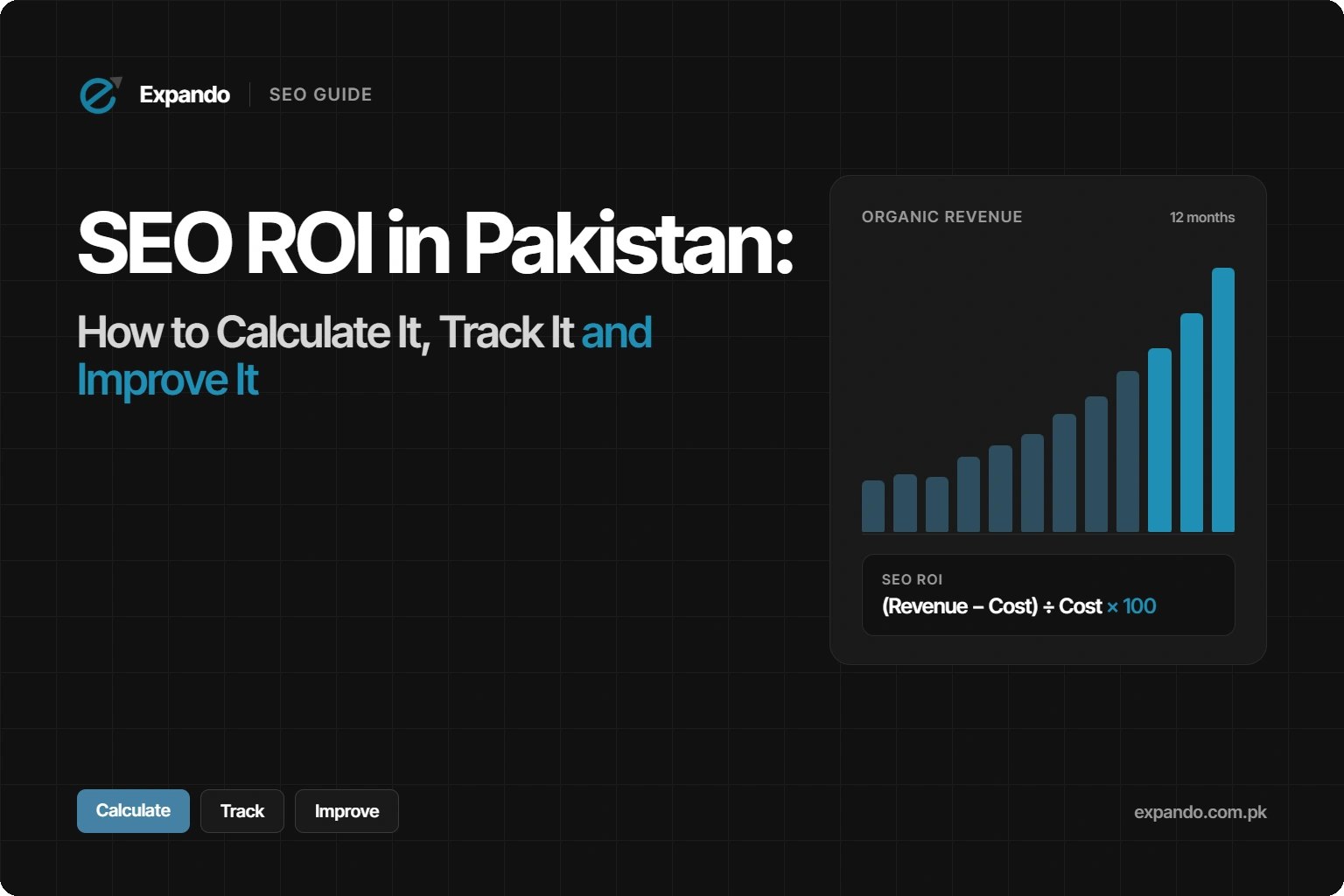
SEO ROI tells you whether organic search is producing more business value than it costs to earn that visibility. It should be measured through revenue, qualified leads and customer value not rankings or traffic alone.
What is SEO ROI?
SEO ROI, or return on investment from SEO, measures the financial return generated by organic search compared with the money spent on SEO. It helps a business owner answer a practical question: is the investment in SEO producing more value than it costs?
The standard SEO ROI formula is:
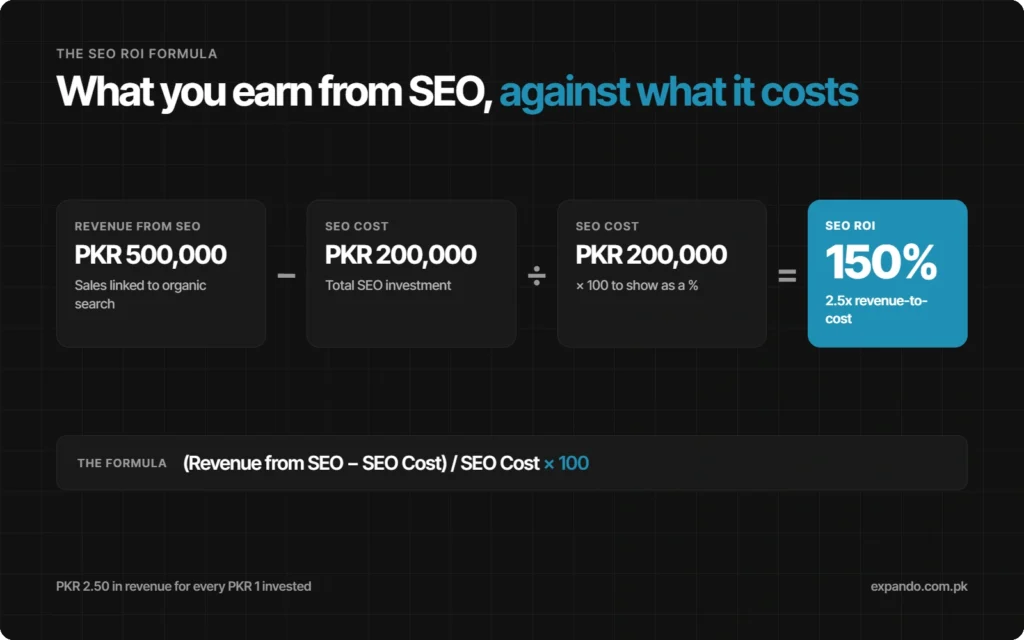
SEO ROI = (Revenue from SEO − SEO Cost) / SEO Cost × 100
For example, if organic-search revenue is PKR 500,000 and the SEO investment is PKR 200,000, the calculation is:
(PKR 500,000 − PKR 200,000) / PKR 200,000 × 100 = 150% ROI
That means the SEO work produced a return equal to 150% of the amount invested, after recovering the original SEO cost. You can also express this as a 2.5x revenue-to-cost multiple: PKR 2.50 in revenue for every PKR 1 invested.
For some businesses, revenue alone is not the best profitability measure. If product margins differ significantly, calculate a second view using gross profit or contribution margin instead of revenue; it gives a clearer picture of whether SEO-generated sales are commercially worthwhile.
What does a 20% ROI actually mean?
A 20% ROI means that for every PKR 100 invested, the business receives PKR 120 back in total: the original PKR 100 plus PKR 20 in return. It can also be described as a 1.2x return on the investment.
The distinction matters because a 20% ROI is not the same as “20% of revenue.” It describes the gain after comparing the return against the amount spent.
For a simple example, imagine an SEO investment of PKR 100,000 produces PKR 120,000 in attributable value. The gain is PKR 20,000, and the ROI is:
(PKR 120,000 − PKR 100,000) / PKR 100,000 × 100 = 20%
A positive ROI means organic search is generating more value than the direct cost used in the calculation. Whether 20% is strong enough depends on the business’s margins, cash flow, sales cycle and other marketing alternatives.
A worked Pakistan business example
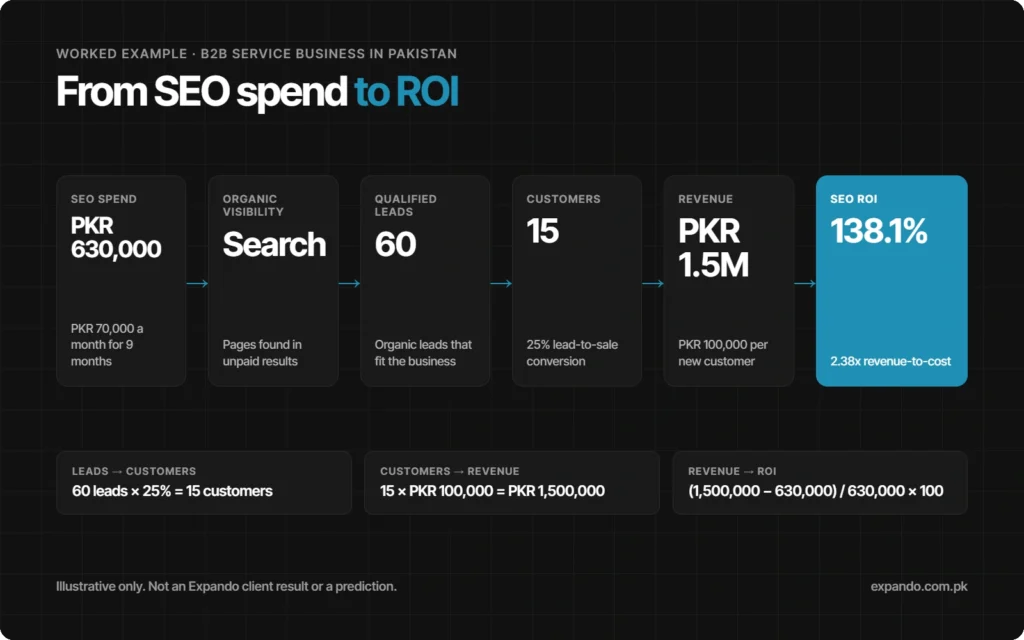
The following example is illustrative only, not an Expando client result or a prediction of what any business will earn. It shows how a Pakistani small or medium-sized business can turn SEO spend, leads and sales data into a practical ROI calculation.
Let’s say a B2B service business in Pakistan invests PKR 70,000 per month in SEO. This sits within a realistic small-to-mid agency market context, but the actual right budget depends on the industry, competition, website condition and commercial goal.
Assume the business maintains that investment for nine months:
|
Item |
Illustrative figure |
|
Monthly SEO investment |
PKR 70,000 |
|
Investment period |
9 months |
|
Total SEO cost |
PKR 630,000 |
|
Organic qualified leads generated during the period |
60 |
|
Lead-to-sale conversion rate |
25% |
|
New customers from organic search |
15 |
|
Average attributable revenue per new customer |
PKR 100,000 |
|
Total attributable organic revenue |
PKR 1,500,000 |
The lead-to-sale calculation is:
60 qualified organic leads × 25% conversion rate = 15 new customers
The revenue calculation is:
15 new customers × PKR 100,000 average revenue = PKR 1,500,000
The SEO ROI calculation is then:
(PKR 1,500,000 − PKR 630,000) / PKR 630,000 × 100 = 138.1% ROI
In plain language, this hypothetical business spent PKR 630,000 and generated PKR 1.5 million in attributable organic-search revenue over the measurement period. That is approximately a 2.38x revenue-to-cost multiple, or a 138.1% ROI.
The point is not that every business should expect this number. A lower-ticket local service, a new e-commerce store, a high-consideration B2B company and an established brand will all have different lead volumes, sales cycles and customer values.
The right approach is to use your own inputs: SEO cost, organic leads, close rate, average order value and, where relevant, customer lifetime value. This turns “is SEO worth it?” from a vague opinion into a measurable business question.
What to track to measure SEO ROI properly
SEO ROI should be tracked through conversions, qualified leads, attributable revenue and customer lifetime value. Traffic and keyword rankings are useful diagnostic metrics, but they are not proof of commercial return by themselves.
Organic conversions
An organic conversion is a meaningful action completed by a visitor from unpaid search results. Depending on the business, this could be a lead form submission, phone call, WhatsApp enquiry, product purchase, demo request, quote request or booked consultation.
Set up conversion tracking before judging SEO performance. If Google Analytics, CRM records or call tracking cannot identify which leads came from organic search, ROI calculations become guesses.
Not every conversion has the same value. A newsletter signup may be useful, but it should not be counted the same way as a qualified enquiry or completed sale.
Qualified leads, not just lead volume
A qualified lead is a lead that fits the business’s actual service, product, budget or location criteria. Ten poor-fit leads can be less valuable than two enquiries from high-intent buyers.
Marketing and sales should agree on what qualifies as a lead. For example, a B2B company may distinguish between a generic contact form, a decision-maker consultation request and an enquiry that has reached a sales-qualified stage.
This prevents an agency or internal team from optimising only for cheap enquiry volume. SEO ROI improves when organic search attracts visitors who are genuinely likely to become customers.
Revenue attributable to organic search
Revenue attributable to organic search is the sales value linked to customers who first found, or meaningfully re-engaged with, the business through unpaid search. For e-commerce, this may be available directly through analytics and transaction tracking; for lead-generation businesses, it often requires CRM discipline.
Use one consistent attribution approach and document it. A long sales cycle may mean a visitor discovers the business through organic search, returns later through another channel, then converts after a sales conversation.
The goal is not to claim every sale for SEO. The goal is to record the role organic search genuinely played so management can make better investment decisions.
Customer lifetime value
Customer lifetime value, or CLV, is the estimated value a customer brings over the full relationship rather than only their first purchase. It is particularly important for subscription businesses, repeat-purchase e-commerce stores, professional services and businesses with renewals or retainers.
A campaign may look unprofitable if you use only the first transaction value, while becoming highly valuable when repeat revenue is included. Use a conservative CLV estimate and update it as real retention data becomes available.
Why SEO ROI takes time
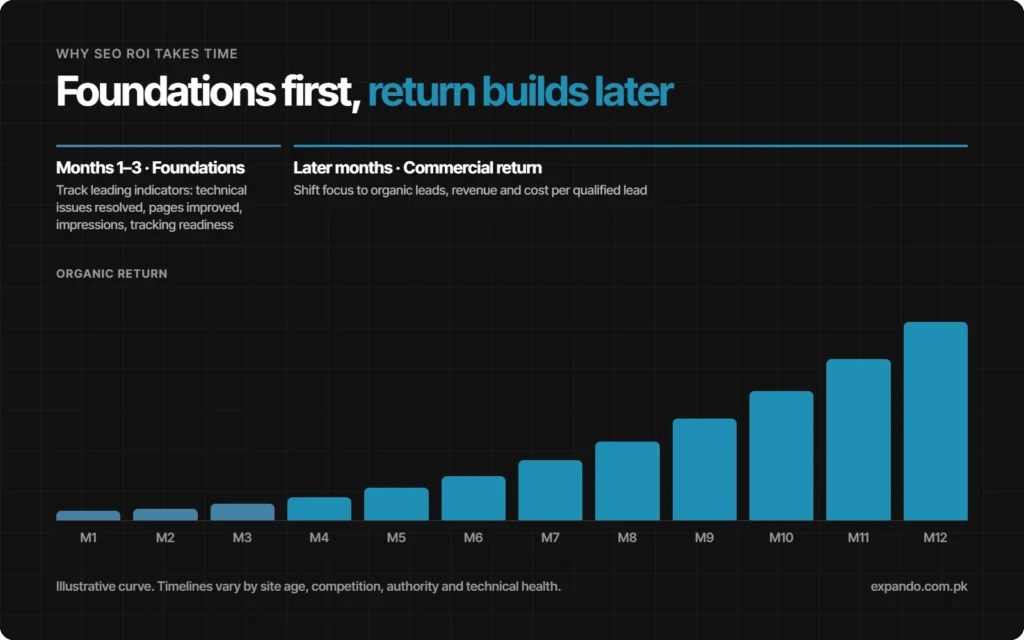
SEO ROI often looks weak in the first one to three months because organic growth compounds over months rather than weeks. Early work usually involves research, technical fixes, content improvement, tracking setup and building a stronger base for pages that have not yet earned visibility.
This is why a fair SEO evaluation window is different from evaluating a short paid-media campaign. A paid campaign can generate immediate clicks once switched on; SEO usually needs time for content discovery, indexing, relevance signals and conversion improvements to take effect.
Early reporting should still be useful. In the first phase, track leading indicators such as technical issues resolved, commercial pages improved, organic impressions, qualified query visibility and conversion tracking readiness.
Later, shift the focus toward organic leads, revenue and cost per qualified lead. The exact timeline varies by site age, market competition, existing authority, technical health and how quickly the business can implement recommended changes.
A business should not wait indefinitely without evidence of progress. Good SEO reporting shows what has been done, what has changed, what remains uncertain and which commercial outcomes are expected to be measured next.
How to improve SEO ROI
SEO ROI improves when a business focuses effort on pages and searches that are closest to revenue, then removes the barriers preventing those visitors from converting. Better rankings matter, but ranking position alone does not create ROI unless the right audience arrives and takes a valuable action.
Prioritise revenue-focused pages
Prioritise pages connected to products, services, categories, locations and high-intent buying questions. A page that attracts fewer but better-qualified visitors can be more valuable than a high-traffic article that rarely leads to commercial action.
Map target queries to the page that should own that intent. This reduces content overlap and makes it easier for users and search engines to find the most relevant page.
Improve landing-page conversion rate
Improving conversion rate can increase SEO ROI without gaining a single additional ranking. A clearer offer, stronger proof, accessible contact options, faster pages and a simpler enquiry path can turn more existing organic visitors into leads.
Review the experience after the click. If a commercial page ranks but does not explain the service, answer objections or make contact easy, traffic alone will not solve the problem.
Refresh high-performing existing content
Refreshing content that already earns impressions, rankings or conversions can be more efficient than creating only new pages. Update accuracy, strengthen commercial relevance, improve internal links and add useful answers to the questions users actually ask.
The goal is not to rewrite pages for the sake of freshness. Refresh content where the existing demand, ranking opportunity or conversion path makes the work commercially meaningful.
Strengthen internal linking
Internal links help users and search engines move between relevant pages. A well-placed link from an informational guide to a related service, category or case-study page can support a clearer commercial journey.
Internal linking is not about adding links everywhere. It is about connecting pages where the next step is genuinely helpful and where the linked page answers the visitor’s likely follow-up question.
Fix technical issues that cap growth
Technical issues can limit the value of otherwise good content. Crawlability, indexability, redirects, page speed, duplicate content, broken internal links and poor mobile experience can all reduce organic performance or create unnecessary friction.
Technical fixes should be prioritised by impact. The right question is not “how many issues did we close?” but “which issues were stopping important pages from being discovered, understood or converted?”
Want help applying this to your business? Expando begins engagements with a 90-minute working session to understand the commercial context before proposing a route forward. Explore Expando’s SEO services.
How much does SEO cost in Pakistan?
General SEO pricing in Pakistan commonly ranges from around PKR 20,000 to PKR 250,000+ per month, depending on the provider type, scope and competitive difficulty. These are general market ranges, not Expando’s specific rates.
|
Provider type |
General monthly market context |
|
Freelancers |
Roughly PKR 20,000–50,000 |
|
Small-to-mid agencies |
Roughly PKR 50,000–150,000 |
|
Enterprise or premium engagements |
Roughly PKR 150,000–250,000+ |
A lower-cost SEO package is not automatically a better investment. If it focuses on low-value rankings, weak content or activity that cannot be connected to leads and revenue, its apparent saving may produce worse ROI than a more capable programme.
Likewise, a higher monthly cost is not proof of quality. Ask what work is included, how commercial outcomes will be tracked, which pages or opportunities will be prioritised, and how results will be reported.
Is SEO still worth it in 2026?
Yes, SEO is still worth it in 2026, but successful SEO now means more than ranking a blue link for a keyword. AI Overviews, AI Mode and answer-engine search are changing how visibility translates into clicks, so businesses need useful, technically sound content that can be surfaced, cited and trusted.
Google’s current guidance says foundational SEO practices remain relevant for generative search experiences because those systems rely on its core Search ranking and quality systems. developers.google.com
That means SEO still involves technical accessibility, clear site structure, useful pages, original expertise and strong page experience. It also means avoiding shallow content produced only to chase every query variation or assumed AI-search “hack.”
For business owners, the practical shift is measurement. Monitor conventional organic traffic and conversions, but also pay attention to how answer-led search changes visibility, branded demand and the quality of visitors reaching your site.
SEO remains worthwhile when it is tied to measurable business outcomes and adapted to how people actually search. It is less worthwhile when treated as a fixed checklist of rankings with no connection to leads, revenue or customer value.
SEO ka ROI kaise nikalte hain?
SEO ROI is calculated by subtracting your total SEO cost from revenue attributable to organic search, dividing the result by SEO cost, then multiplying by 100. The formula is: (Revenue from SEO − SEO Cost) / SEO Cost × 100.
To calculate it accurately, track which qualified leads and sales came from organic search rather than looking only at traffic or rankings. If your sales cycle is long, use CRM data and a consistent attribution method to connect organic enquiries with closed revenue.
Frequently Asked Questions
How much can we earn from SEO in Pakistan?
There is no universal amount a business can earn from SEO in Pakistan because results depend on industry, search demand, competition, execution quality, conversion rate, pricing and customer lifetime value. The correct estimate is built from your own model: SEO spend → qualified organic leads → sales conversion → attributable revenue → ROI percentage.
A local service company, e-commerce store and B2B exporter may all invest similar amounts but produce very different returns. Use a worked ROI calculation rather than a generic earnings claim to judge whether SEO is likely to be worthwhile for your business.
What does 20% ROI mean?
A 20% ROI means that for every PKR 100 invested, the business receives PKR 120 back in total: the original PKR 100 plus PKR 20 in return. It is also described as a 1.2x return on investment.
For example, if SEO costs PKR 100,000 and produces PKR 120,000 in attributable value, the gain is PKR 20,000 and the SEO ROI is 20%.
Is SEO still worth it in 2026?
SEO is still worth it in 2026 when it is connected to useful content, technical accessibility, qualified organic demand and measurable business outcomes. AI-driven search changes how some users discover information, but it does not remove the need for clear, useful, crawlable and trustworthy web pages. developers.google.com
The strongest SEO programmes track leads, revenue and customer value rather than treating rankings as the final outcome. Businesses should adapt their measurement as search behaviour evolves.
How much does SEO cost in Pakistan?
SEO in Pakistan commonly costs roughly PKR 20,000–50,000 per month for freelancers, PKR 50,000–150,000 for small-to-mid agencies, and PKR 150,000–250,000+ for enterprise or premium engagements. These are general market ranges, not Expando’s specific prices.
Cost alone does not determine ROI. A lower-cost programme with weak execution can return less value than a more capable investment focused on revenue-producing pages, conversion tracking and technical foundations.