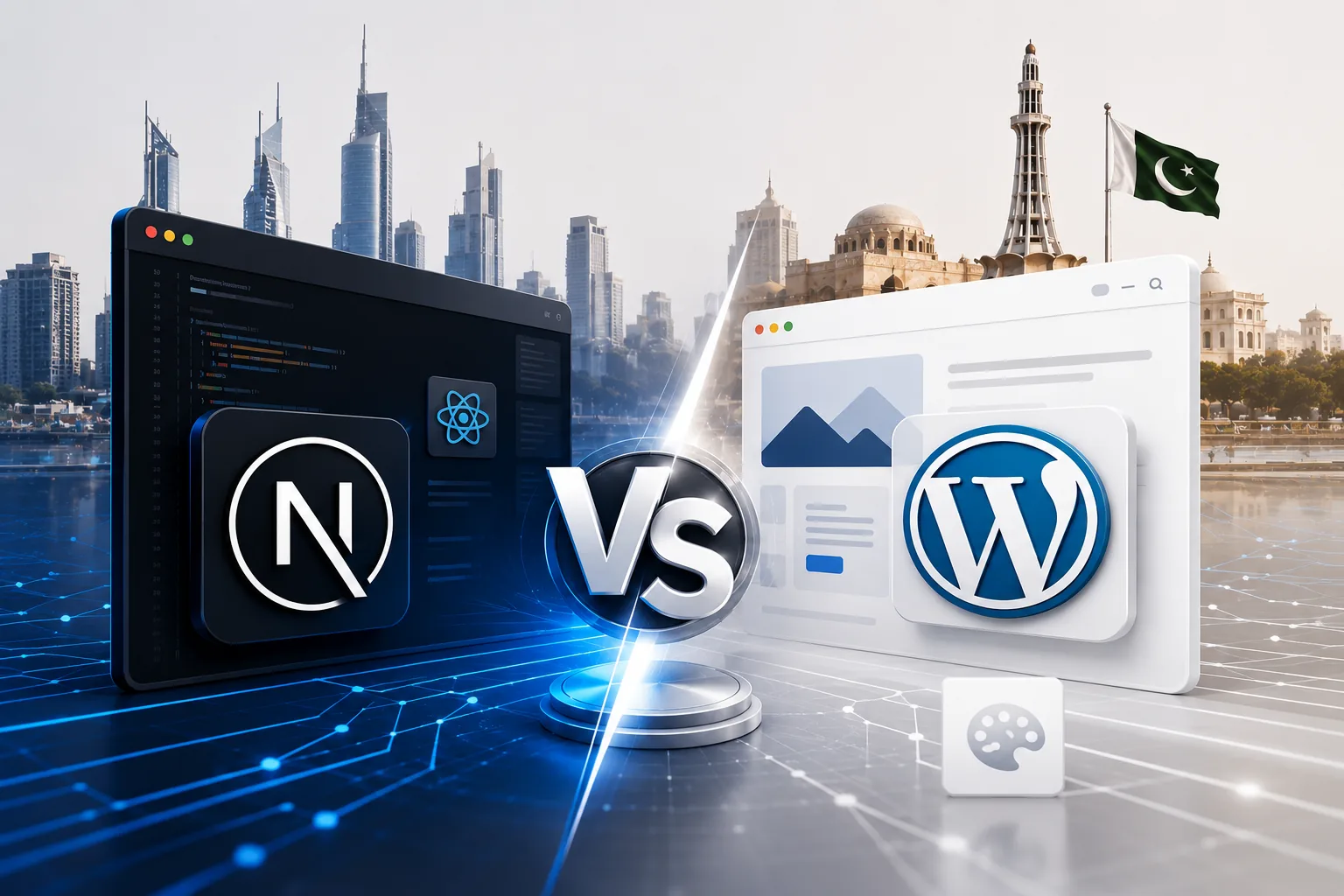
Next.js vs WordPress: The Future of Web Development in Pakistan (2026)
Businesses in Pakistan are no longer choosing a website platform based on convenience. They’re investing in technology that improves search visibility, user experience, and long-term business growth. As Google’s ranking signals grow more performance-focused and as AI search engines like ChatGPT, Perplexity, and Google AI Overviews prioritize technically reliable sources, the choice between WordPress and Next.js has become a strategic business decision, not a technical preference.
Quick Verdict for 2026: High-growth businesses across Pakistan are increasingly adopting Next.js web development because it delivers faster loading speeds, stronger security, better Core Web Vitals, and lower long-term maintenance than traditional WordPress websites. For brands investing in SEO, digital advertising, and scalability, modern headless architecture is a measurable competitive advantage, not a trend.
The Core Architectural Shift: Monolithic vs. Headless Web Development
Traditional websites are built on monolithic architecture the CMS, frontend, backend, database, and plugins all operate inside one environment. This made publishing simple, but it also introduced performance bottlenecks and security risks as sites grew more complex.
Headless architecture separates the frontend from the content layer. Frameworks like Next.js consume data through APIs while rendering an optimized interface independently. This lets developers build faster, more secure, and highly scalable digital experiences without inheriting the limitations of a traditional CMS, which is why more businesses past the brochure-site stage are shifting toward this model.
Why Does Traditional WordPress Struggle with Modern Core Web Vitals?
WordPress remains an excellent publishing platform, but its traditional implementation often fails to meet modern performance benchmarks, especially once plugins, page builders, and third-party scripts accumulate over time.
Common performance issues include:
- Heavy plugin dependencies that each add their own JS/CSS payload
- Increased Time to First Byte (TTFB) from PHP execution and database calls
- Render-blocking CSS and JavaScript loaded on every page
- Database-intensive page generation on every single request
- Frequent compatibility conflicts after core, theme, or plugin updates
These directly hurt Google’s Core Web Vitals Largest Contentful Paint (LCP), Interaction to Next Paint (INP), and Cumulative Layout Shift (CLS). Slower sites see higher bounce rates and weaker paid-advertising efficiency, which is why a performance audit is increasingly the first step in any serious redesign, not an afterthought.
What Makes Next.js the Gold Standard for Scalable Web Applications?
Next.js (built on React.js) was engineered specifically for modern web performance.
Instead of dynamically generating every page on each request, it supports Static Site Generation (SSG), Server-Side Rendering (SSR), Incremental Static Regeneration (ISR), and intelligent edge caching, all of which dramatically cut response times.
Key advantages:
- Lightning-fast page delivery via pre-rendering and edge caching
- Excellent, consistent Core Web Vitals performance
- Built-in image optimization (no plugin required)
- Advanced routing and automatic code splitting
- API-first architecture for clean API integration and database management
- Seamless integration with enterprise services and headless CMS platforms
- Native serverless deployment support (Vercel, AWS)
- Exceptional developer scalability for growing full-stack development teams
For a growing business, this means the website stays fast even as traffic, content, and functionality scale a critical difference for any enterprise website or SaaS platform competing for regional or global customers.
Head-to-Head Comparison: Next.js vs WordPress for Pakistani Enterprises
The comparison below highlights the practical differences that influence website performance, SEO, security, and long-term business growth.
Feature | WordPress (Traditional CMS) | Next.js (Modern React Stack) |
Page Speed (TTFB) | Typically slower PHP execution, plugins, and database queries add latency | Extremely fast pre-rendering, caching, and edge delivery minimize server round-trips |
Security & Vulnerabilities | Frequent plugin/theme vulnerabilities require constant patching | Minimal attack surface custom architecture, API isolation, no unnecessary third-party plugins |
SEO Capabilities | Strong with correct configuration, but heavily plugin-dependent (Yoast, RankMath, etc.) | Built-in performance advantages, server-side rendering, granular metadata control, structured data, strong Core Web Vitals by default |
Scalability | Can become resource-intensive as traffic and content volume grow | Built for enterprise-scale applications with effortless horizontal scaling |
Maintenance Costs | Ongoing plugin updates, security monitoring, hosting optimization, conflict resolution | Lower long-term maintenance cleaner codebase, automated deployments, modern cloud infrastructure |
Best Fit | Brochure sites, blogs, content-heavy publishing, small WooCommerce stores | SaaS products, customer portals, high-traffic e-commerce, SEO/ad-driven growth brands |
How Much Does Website Development Cost in Pakistan? (2026 Pricing Guide)
This is one of the most searched questions in the market “website development company Pakistan price kitna hai” and the honest answer is: it depends entirely on the stack and scope, not just the agency.
WordPress website development in Pakistan typically costs less upfront because it relies on existing themes and plugins rather than custom-engineered code. This works fine for a small business website, a local service brochure, or a basic WooCommerce store.
Next.js website development in Pakistan carries a higher initial investment because every feature is custom-built rather than assembled from pre-made plugins. Businesses recover this investment through:
- Fewer emergency fixes and plugin-conflict tickets
- Lower hosting and server costs at scale (serverless, pay-per-use)
- Higher conversion rates from faster load times
- Reduced security incident costs (fewer patch cycles, smaller attack surface)
Rather than quoting a flat number which varies wildly based on features, integrations, and design complexity, Expando scopes every quote around three inputs: number of custom modules, third-party integrations required (payments, CRM, ERP), and expected traffic/scaling needs. A free technical discovery call gives you an accurate package range instead of a generic estimate.
Next.js Development in Karachi, Lahore, Islamabad & Beyond
Pakistan’s web development demand isn’t concentrated in one city, and neither is Expando’s client base.
Website development in Karachi, Pakistan’s commercial capital, sees the highest demand for e-commerce and fintech-adjacent web applications, where speed and payment-gateway reliability directly affect revenue.
Website development in Lahore: a strong mix of SaaS startups, education platforms, and D2C brands, most of which are scaling past what template-based WordPress builds can handle.
Website development in Islamabad: a heavier concentration of corporate, government-adjacent, and enterprise portal projects, where security and uptime guarantees matter as much as speed.
Rawalpindi, Faisalabad, Multan, and Peshawar: increasingly, textile, manufacturing, and export-focused businesses in these cities are moving to custom Next.js storefronts and B2B portals to compete for international clients who judge credibility partly on site performance.
The underlying technical priorities Core Web Vitals, security, scalability don’t change by city. What changes is the industry mix, and Expando scopes each engagement around the client’s actual sector, not a one-size-fits-all package.
Real-World Agency Perspective: Why Expando Engineers Custom Code
At Expando, we don’t believe every business needs the same technology stack. We recommend solutions based on business objectives, expected growth, and operational requirements not trends.
For brochure websites or content-heavy publishing, WordPress can still be the right call. But businesses investing in SEO, paid advertising, SaaS platforms, enterprise portals, customer dashboards, or high-performance e-commerce see significantly better outcomes with custom development using Next.js.
Our engineering approach focuses on eliminating unnecessary complexity. Instead of relying on dozens of plugins, we build features directly into the application. This results in:
- Cleaner architecture
- Faster websites
- Fewer software conflicts
- Reduced security exposure
- Better long-term maintainability
Many compromised websites in Pakistan are breached through outdated plugins or abandoned themes, not sophisticated attacks. By reducing external dependencies and building custom functionality, we lower the attack surface significantly while giving clients complete control over their digital infrastructure.
Modern deployment platforms like Vercel and AWS make serverless hosting practical and cost-efficient. Automatic scaling, global content delivery, and simplified deployments often reduce infrastructure overhead while improving reliability and uptime.
The ROI Metric: How Website Performance Directly Impacts Your Revenue
Website speed is no longer a technical metric; it’s a revenue metric.
Research across the digital industry consistently shows that even a one-second improvement in load time can meaningfully improve engagement, reduce abandonment, and increase conversions. Faster experiences keep visitors engaged longer, helping businesses retain more users while improving the efficiency of SEO and paid advertising spend.
Performance influences nearly every stage of the customer journey:
- More visitors stay on the website
- More users browse additional pages
- More enquiries and purchases are completed
- Paid advertising delivers better return on investment
- Organic rankings improve as user-experience signals strengthen
For businesses spending significant monthly budgets on Google Ads or Meta campaigns, sending paid traffic to a slow website inflates acquisition costs for no reason. A high-performance Next.js application ensures more of that ad spend converts into leads and sales instead of lost sessions.
In competitive markets, speed is a measurable business advantage, not a technical luxury.
Next.js vs WordPress vs Shopify vs Webflow: Quick Decision Matrix
There’s no one-size-fits-all solution. The matrix below matches common business needs with the platform best suited for long-term growth.
Business Need | Recommended Stack |
Simple blog or content site, low technical requirements | WordPress |
Small online store, standard checkout flow | WordPress + WooCommerce or Shopify |
Marketing site with visual, no-code editing for a small team | Webflow |
High-traffic e-commerce, custom checkout, advanced integrations | Next.js + headless commerce backend |
SaaS product, customer dashboard, enterprise portal | Next.js (custom full-stack build) |
SEO- and ad-driven growth brand competing on Core Web Vitals | Next.js |
Wix and Squarespace remain viable only for very small, low-traffic personal or hobby sites neither is built for the scale or SEO competitiveness most Pakistani businesses are now targeting in 2026.
How to Choose a Website Development Company in Pakistan (Red Flags to Avoid)
The market is crowded, and complaints about delayed projects, overpriced quotes, and non-responsive agencies are common enough to warrant a checklist before signing anything.
Watch for these red flags:
- Vague pricing if an agency can’t explain what’s driving the cost (features, integrations, hosting), the quote isn’t reliable.
- No technical discovery process: an agency that quotes a price before understanding your traffic, integrations, and growth plans is guessing.
- Portfolio without live, testable links: screenshots aren’t proof of performance; ask for live Core Web Vitals scores on their past work.
- No post-launch support terms: get maintenance, hosting, and update responsibilities in writing before starting.
- Overreliance on unnamed “AI-powered” development: speed matters, but so does code ownership and long-term maintainability.
A credible website development company in Pakistan will walk you through architecture choices (WordPress vs Next.js vs Shopify), give a scoped price range tied to specific deliverables, and show live examples not just portfolio screenshots.
Key Takeaways: Next.js vs WordPress Checklist
Choose Next.js if your business needs:
- ✓ A high-performance website optimized for Core Web Vitals, SEO, and AI-powered search experiences
- ✓ Enterprise-grade security with minimal reliance on third-party plugins
- ✓ Scalable architecture for growing traffic, customer portals, SaaS products, or modern e-commerce
- ✓ Lower long-term maintenance through custom development and cloud-native deployment
Choose WordPress if your business needs:
- ✓ A simple brochure site or blog with low technical complexity
- ✓ Fast, budget-friendly launch using existing themes and plugins
- ✓ A small WooCommerce store with standard, low-traffic requirements
Frequently Asked Questions
Is Next.js more expensive than WordPress development in Pakistan?
The initial investment is generally higher because Next.js applications are custom-engineered rather than assembled from plugins and themes. Most businesses recover that investment through improved performance, stronger security, fewer maintenance issues, and better conversion rates over time.
Can an existing WordPress site be migrated to a headless Next.js architecture?
Yes. Existing WordPress content can often be preserved while the frontend is replaced with a Next.js application. This headless approach lets businesses keep familiar content workflows while delivering a significantly faster, more secure user experience.
Which stack is better for e-commerce websites in Pakistan?
For small stores with straightforward requirements, WordPress with WooCommerce is sufficient. For brands expecting high traffic, advanced integrations, superior checkout performance, or enterprise scalability, Next.js paired with a modern commerce backend offers far greater flexibility and growth potential.
How much does website development cost in Pakistan in 2026?
Cost depends on the stack, number of custom features, and integrations required not a fixed market rate. WordPress builds are generally cheaper upfront; Next.js builds cost more initially but reduce long-term maintenance and hosting overhead.
Which website development company is best in Karachi, Lahore, or Islamabad?
The “best” fit depends on your industry and technical requirements more than your city. The vetting checklist above (pricing transparency, discovery process, live portfolio proof) applies the same way regardless of location.
How long does website development take in Pakistan?
A standard WordPress brochure site typically takes 2–4 weeks. A custom Next.js application, depending on features, integrations, and testing, usually takes 6–12 weeks for a production-ready build.
What is the difference between WordPress and Next.js?
WordPress is a monolithic CMS where content, frontend, and backend operate together in one system. Next.js is a headless framework that separates the frontend from the content layer, consuming data via APIs for faster, more customizable, and more scalable performance.
Which CMS is best for website development in Pakistan?
For content-heavy publishing with low technical needs, WordPress remains a strong choice. For SEO-driven, ad-funded, or scale-focused businesses, a headless setup WordPress as a content backend with a Next.js frontend, or a dedicated headless CMS performs significantly better.
Website development company Pakistan konsi best hai?
Yeh depend karta hai aapke business ki zaroorat par. Agar simple brochure site chahiye to WordPress kaafi hai, lekin agar SEO, speed, aur scalability priority hai to Next.js based custom development zyada reliable hoti hai. Best agency wahi hai jo pehle discovery call karke aapki requirement samjhe, phir price quote de.
Website development company Pakistan price kitna hai?
Price fixed nahi hoti; yeh features, integrations, aur platform (WordPress ya Next.js) par depend karti hai. WordPress websites generally sasti shuru hoti hain, jabke custom Next.js applications zyada invest maangti hain lekin long-term maintenance cost kam kar deti hain.
Ready to Scale Your Digital Infrastructure in Pakistan?
Your website should be more than an online brochure it should be a high-performing business asset that supports SEO, digital marketing, lead generation, and long-term growth.
At Expando, we design and build modern web applications that combine the performance of Next.js with scalable cloud infrastructure and a conversion-focused user experience. Whether you’re replacing a slow legacy website, modernizing an existing WordPress platform, or launching a new digital product, our team delivers solutions engineered for speed, security, and measurable business results.
If you’re ready to move beyond outdated technology and build a sub-second web application that supports your business for years to come, book a free technical discovery call with our team today at expando.com.pk. We’ll assess your current platform, discuss your goals, and recommend the most effective architecture for sustainable digital growth.